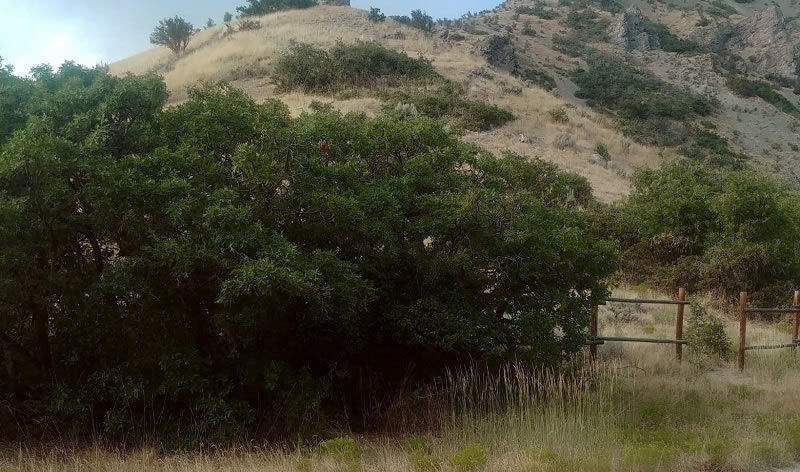
Site of the Battle Creek Canyon Massacre, Pleasant Grove, Utah
The Mormon's Black Hawk War
1848 to 1870
The definitive cause of the Black Hawk War in Utah was settler colonialism in the Great Basin and Brigham Young's order to exterminate the Timpanogos Nation beginning in 1849. Which continued to escalate over 25 tumultuous years: more than a million dollars in Church funds, over 150 bloody encounters, and thousands of deaths. Terror reined throughout the Great Basin, Provo, Springville, Spanish Fork, Payson, Heber, Ephraim, Circleville, and beyond. Contrary to what many believe,
congress never ratified a single treaty. See Black Hawk War Treaties
Author Phillip B Gottfredson is the first to explore the tragic fate of not only the Timpanogos, but all the Tribes of Utah. "I was confronted with uncomfortable truths told to me by the Timpanogos that cast a dark shadow on the romanticized version of Mormon benevolence of performing kind and charitable acts toward the Indigenous people of Utah. I served a two-year mission for the Church, It was gut-wrenching laying bare the gritty realities of conflict, life, and death," remarked Phillip.
Settler Colonialism and the Timpanogos of the Great Basin
According to Cornell Law School, "Settler Colonialism can be defined as a system of oppression based on genocide and colonialism, that aims to displace a population of a nation (oftentimes indigenous people) and replace it with a new settler population."
The Mormon's Black Hawk War in Utah was a disgraceful affair. The Church of Jesus Christ of Latter-day Saints (Mormons) never rescinded Brigham Young's "Extermination Order No. 2" of the Timpanogos. They justify stealing Indigenous resources and land by proclaiming that their religion and culture are superior to all others. Then they give Indigenous people a book that says thou shalt not steal.
The Timpanogos Nation Had No Choice But War
 The Late Loya Arrum of the Ute Tribe of the Uintah Ouray Reservation put it succinctly when she said to Phillip over a decade ago, "The Truth must be told, regardless of what happened."
Quoting from Timpanogos Chief Wakara in a statement to Indian Agent M. S. MARTENAS July 6, 1853. "They were friendly for a short time until they became strong in numbers, then their conduct and treatment towards the Indians changed—they were not only treated unkindly—they have been treated with much severity—they have been driven by this population from place to place—settlements have been made on all their hunting grounds in the valleys, and the graves of their fathers have been torn up by the whites..." See Timpanogos Chief Wakara's full Statement.
Perry Murdock, a council member of the Timpanogos Nation and a direct descendant of Chief Wakara, had this to say about the Black Hawk War in Utah, "Every day we are reminded of what our ancestors went through. Our families were torn apart. Children murdered, the old, the women, all those who were brutally murdered and made to suffer and die from violence, then disease, then starvation, our ancestors' graves torn up, the land destroyed, it was genocide plain and simple. Why? What did we do? We didn't do anything. We were living in peace. We were happy. Our children were happy. We loved each other. We cared for each other. And when the Mormons came, we tried to help them. Then they tried to take everything away from us. They wanted it all. They wanted to exterminate us, wipe us off the face of the earth. Why? For our land? For our oil? Now we have nothing."
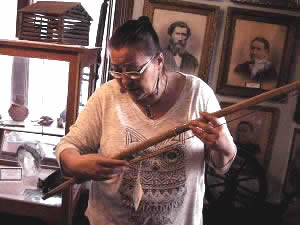 Mary Murdock Meyer, direct descendant of Chief Arapeen, brother of Wakara, wrote, "As Chief Executive of the Timpanogos Nation, I speak for the people when I ask why? We fed you when you were hungry. We helped you when you did not understand our lands. Why then were we forgotten?"
Why can Utah not speak truthfully and responsibly about the history of First Nations peoples? Enough with the sugarcoating and homogenizing of Utah's Black Hawk War history! It seems that discomfort with the truth often leads to its disguise in fluffy clouds of cotton candy, which Latter-day Saints seem to favor. For instance, Church historians' alternative facts suggest that the war took place between 1865 and 1872, ignoring the previous 25 years of relentless ill-treatment and frequent cold-hearted brutality of the Timpanogos Nation. See Biography of the Timpanogos Tribe
Tragedy began in the winter of 1848-49, Brigham, who was the leader of the Latter-Day Saints, falsely accused a small group of the Timpanogos Nation of stealing his horses. This accusation led to the unapologetic deaths of three innocent individuals and the capture of a young boy named Black Hawk, known as the Battle Creek Canyon Massacre, Pleasant Grove, Utah.
Examples of brutality are numerous; the murder of a Timpamogos Elder, the Mormons called Old Bishop, occurred on the 1st of August, 1849, at Fort Utah in Provo. Accused of stealing a shirt from a clothesline, he was shot in cold blood, disemboweled, his stomach filled with rocks, and thrown in the Provo River. See The Murder of Old Bishop
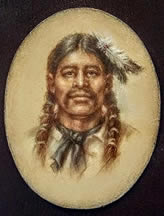 The Timpanogos recall the terrifying massacres in 1850, Colonel George D. Grant, money-hungry Dr. Blake, and "Wild Bill" Hickman savagely killed some 70 Timpanogos at Provo, Fort Utah. Dr. Blake sold their decapitated heads to science for profit. See The Massacre at Fort Utah
In the Mountain Meadows Massacre, 1857, Major John D. Lee of the Nauvoo Legion led a ragtag band of Latter-day Saints disguised as Indians in an assault on a wagon train from Arkansas, murdering 120 men, women, and children. The LDS Church unfairly blamed the Paiute. In 2007, the Church of Jesus Christ of Latter-day Saints, after decades of denial, finally confessed to the Mountain Meadows Massacre. Also, in 2007, the late David O. Mckay said, "By their fruits ye shall know them."
In the Bear River Massacre of 1863, over 493 Shoshoni were slaughtered, led by the unashamed Colonel Patrick Edward Connor. Brigham young supplied Connor with troops and equipment.
Then at the peak of the Black Hawk War in 1866, Bishop William Jackson Allred led the Circleville Massacre of the Koosharem Paiutes. Twenty-six men, women, and children's throats were slit and buried in a mass grave. See The Circleville Massacre
Despite the numerous attempts by Timpanogos leaders to live in peace, Mormon settlers treated them with much severity; one of the most notable examples is the robbery of Chief Black Hawk's grave. On September 26, 1870, his loving kin honorably laid him to rest on a hillside  overlooking Spring Lake, the place of his birth—just 49 years passed when Mormons dug up his mortal remains and then exhibited them in the window of a hardware store, and on Temple Square in Salt Lake City for amusement. You don't see Indigenous people digging up whiteman's graves. See Chief Black Hawk's Burial.
Our informative Timeline of the Black Hawk War shows any number of unheard-of or forgotten battles that Peter Gottfredson recorded, such as the Richville Raid, the Grass Valley Massacre, numerous other hell-like consequences of Settler Colonialism, and the remarkable resilience of those who endured.
It is a ridiculous assumption that the War began in 1865, and the primary cause of Utah's Indian wars was "Indians lust for Mormon cattle," when it was greed and bigotry of European colonists who wanted it all.
Though it is difficult to determine the exact number, scholars estimate that some 70,000 indigenous people occupied the Great Basin when the Latter-Day Saints arrived. At the war's end, Brigham Young proudly boasted, "I don't think there is one out of ten, and perhaps not even one out of a hundred, who were here when we arrived." This statement suggests that the death toll of the Timpanogos was alarmingly high. Settlers deliberately caused starvation and spread diseases that led to a 90% decrease in Utah's Indigenous population.
We must concede that our European ancestors were descendants of the colonial mentality of domination and subjugation. See Truth In Utah's History Of First Nations Peoples
Doctrine of Discovery & Manifest Destiny
Peter d'Errico, Legal Studies Department, University of Massachusetts/Amherst, wrote, "Papal authority is the basis for United States power over indigenous peoples." The Doctrine of Discovery, a five-hundred-year-old decree by Catholic monarchs during the 14th century, was a law based upon Christian doctrine, believing that their religion and culture were above all others, giving Christians and governments throughout the world a legal and moral justification to invade and occupy Native American land. See Videos for more Information.
Note: Pope Francis has renounced the 500 year old Doctrine of Discovery as of March 2023.
Another example of Settler colonialism in America is Andrew Jackson's systematic 200.jpg) Indian Removal Act of 1830 that opened the way to the forced relocation of Native Americans. It became known as "the Trail of Tears." The 1832 Supreme Court Ruling declared the Indian Removal Act unconstitutional, but the damage already caused to First Nations was irreversible. In time, the Doctrine of Discovery would become Manifest Destiny to justify Settler Colonialism further.
Indian Removal Act of 1830 that opened the way to the forced relocation of Native Americans. It became known as "the Trail of Tears." The 1832 Supreme Court Ruling declared the Indian Removal Act unconstitutional, but the damage already caused to First Nations was irreversible. In time, the Doctrine of Discovery would become Manifest Destiny to justify Settler Colonialism further.
Extermination
When the Civil War ended in 1865, the United States government called for exterminating tribes who resisted giving up their land, and the Government turned its attention toward Western expansion and the U.S. military to 'Indian' fighting. See CONGRESSIONAL ACTS
By 1865 the Mormon's extermination order had already resulted in over 40 bloody encounters. Mormon settlers made a mockery of Native American lifeways, leaving a deep wound as Settler Colonialism became institutionalized and continues to shape the present, impeding efforts toward reconciliation and acknowledgment of historical injustices.
Eliminating 'Indianness' Through Acculturation
Highly publicized massacres of 'Indians' brought the attention of philanthropic groups. American humanitarians proposed a new solution to the 'Indian problem' by eliminating 'Indianness' through acculturation. Christian reformers argued that 'if Indians were assimilated, the Indian problem would vanish.'
In the 1860s, the U.S. adopted a Peace Policy, gradually shifting toward a more peaceful approach, and genocide of Native Americans was officially discouraged. The Peace Policy meant making them wards of the government, forcing Native tribes to reservations and boarding house schools to assimilate them into white culture, thus eliminating Native peoples bloodlessly. The intended effect of the Peace Policy was to prevent the rampant slaughter of Native Americans.
A New 'ism' Takes Hold Among Colonists, "Racism"
"Race was a fairly new concept among early colonists," wrote Sean P. Harvey, Ph.D. author of Native Tongues available in our bookstore. "The concept of 'Race' that took hold in the 1800s created physical and cultural divisions in humanity. It is essential to understand that it was crucial to early American settler colonialism. It provided the foundation for the colonization of Native Land and the enslavement of Native Americans and Africans."
Hildalgo Treaty of 1848
Even though Utah wouldn't become a state until 1896, it should be noted that Mormon settlers arrived on the Wasatch Front of the Rockies during the Mexican-American War.
In February 1848, the Treaty of Guadalupe Hidalgo ended the Mexican-American War. The significance of the treaty is that it preserved certain Indian rights. According to the Constitutional Rights Foundation, "Mexican negotiators won from the United States multiple promises that Indian land rights would continue as they had been under Mexican law."
Disregarding the Timpanogos' indigenous and treaty rights, Mormon leadership drew their power from the Doctrine of Discovery and Manifest Destiny. Ignoring the supreme laws of the land, LDS Apostle George A. Smith ordered the church's private militia to "remove the Indian people from their land," saying Indigenous people have "no rights to their land." Brigham Young spent over a million dollars in church funds, the equivalent of $35 million today, to "exterminate" them. See Memorial of the
Legislative Assembly of Utah
"We're Christian, white, and superior."
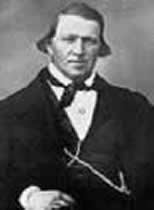 In 1847, Mormons faced ever-increasing hostilities when angry mobs forced them to leave Illinois—following the assassination of Latter-Day Saint Church founder Joseph Smith, a polygamist having 40 wives, and member of the Masonic Order. Joseph Smith's successor Brigham Young, with 55 wives, led a massive migration of followers to colonize the Great Basin of the Rocky Mountains in Utah. Aligned with the "Chosen People-Promised Land" model of the Bible," Christians rationalized they were superior and had a God-given right to Native American land.
Christianization, education, and cultural development became the means to 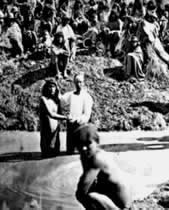 assimilate tribal peoples so that they could be integrated and absorbed by mainstream society. Example, the LDS church converted many of Utah's Native Americans to Mormonism, according to church doctrine, and in so doing, the so-called "loathsome" Indians would become a "white and delightsome people." They would be forgiven of the sins of their forefathers. (Book of Mormon 2 Nephi 5:21-23) According to church doctrine, the nature of the dark skin was a curse, and the cause was the Lord; the reason that the Lamanites (Indians) "had hardened their hearts against him, (God)," and the punishment was to make them "loathsome" unto God's people who had white skins. See Only In The Land Of The Lamanites
Young understood that ultimate domination was key to 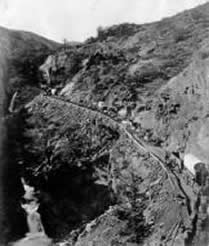 taking possession of Indigenous occupied land. At the rate of some three thousand a month, new Mormon arrivals sprawled out into the ancestral home of the Timpanogos, upsetting the natural order of all living things for Indigenous civilizations. They killed deer, elk, and buffalo and depleted the fish population in the Timpanogos River (Provo River) and Timpanogos Lake (Utah Lake). They diverted and polluted water sources, the environment that First Nations solely depended upon for food, medicines, and life-sustaining necessities. With the rapid increase in the Mormon population, agricultural development, and barbwire, the Timpanogos soon ran out of territory for sanctuary vital to their culture.
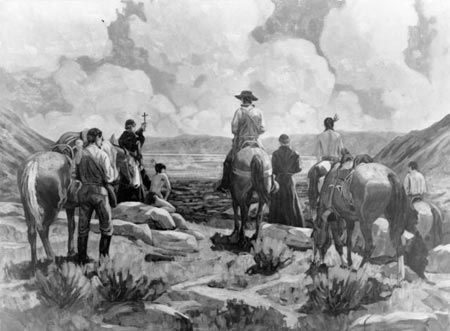
Dominguz and Escalante entering Utah Valley in 1776 artist Paul Stansbury
The Timpanogos Nation of the Wasatch
Most significant to our narrative on the Black Hawk War is that the Timpanogos who, according to reliable sources, are the most documented Tribe in Utah. The Timpanogos are not Ute. Early Spanish explorers and scholars have written, recorded, and reported their history since 1776. Then why have they virtually been erased from Utah's history? Adding insult to injury, misinformation and disinformation about the Timpanogos have developed over time, and people have become deluded into believing that they are Colorado Ute. See Mistaken Identity of Timpanogos & Ute Tribes page for a detailed account of these topics.
Did Mormons try to help the Timpanogos?
We either forget or haven't been told that some of our ancestors had deep and meaningful relationships with the Timpanogos, and we need to acknowledge that. In 1866, when Chief Black Hawk had been wounded in battle at Gravely Ford, Canute Peterson of Ephraim paid a visit to the ailing leader Black Hawk—taking sugar, hams, bread, beads, molasses, tea, coffee, tobacco, flour, medicines, and clothing. Sadly, important stories such as this get buried in all the rhetoric. See The Old Peace Treaty Tree.
Reconciliation, what reconciliation?
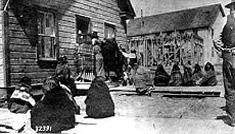 Suppose you were Indigenous person and lucky enough to survive the war. In that case, you are confined to a reservation and made to depend on government-run Indian agencies for scarce and sometimes contaminated commodities to survive. Your children are taken away and sent to boarding house schools with graveyards, all under the slogan "Kill the Indian, and save the man." There has never been any reconciliation, remorse, or even an apology from those who believe God led them to a promised land, and call themselves latter-day saints.
Brigham Young lays all the blame on his followers he described as "stupid, cork for brains and wooden shoes." In his speech in the Tabernacle, Salt Lake City, on April 6, 1854, he said, "If the inhabitants of this Territory, my brethren, had never condescended to reduce themselves to the practices of the Indians, (as few of them have,) to their low, degraded condition, and in some cases even lower, there never would have been any trouble between us and our red neighbors." See Brigham Young's Discourses.
The Denver Rocky Mountain newspaper quoted Brigham Young saying, "You can get rid of more Indians with a sack of flour than a keg of powder." Clearly his intention was to "get rid" of the indigenous population. Mormon colonialism had less to do with saving the "heathens" from hell, and more to do with getting rich.
Black Hawk War Treaties
"We took from them almost all their land—the reservations are just a tiny remnant of traditional tribal homelands. We tried to take from them their hunting rights, their fishing rights, the timber on their land. We tried to take from them their water rights. We tried to take from them their culture, their religion, their identity, and perhaps most importantly, we tried to take from them their freedom." -Professor Dr. Daniel McCool University of Utah.
Historian Floyd O'Neil famously said, "You can't stretch a rat's ass over a rain-barrel." He explained, "No treaties were made between the Indian people of Utah and the Church of Jesus Christ of Latter-day Saints (Mormons); 'agreements' were made between the Mormon Church and the indigenous people. At best, these agreements were divisive to trick the Indians into giving up their land," he said.
The Legacy of the Black Hawk War is that the war caused tremendous obstacles for Indigenous people living in the Great Basin. History ignored the Timpanogos Nation, leaving them out of Utah's historical narrative in favor of the Colorado Utes. They have survived severe economic issues, sovereign and aboriginal rights violations, and boarding house schools. According to the July 10th, United States Tenth District Court ruling of 2017, Utah has no jurisdiction over the Uinta Valley Reservation whatsoever. Still, "they take whatever they want," said Tribal members living on the Reservation, "The war over treaty rights never ends."
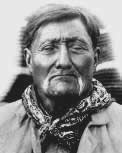 By 1871, Congress created the Appropriations Act, which forced America's Indigenous people onto reservations when they were then made Wards of Government, thus giving Congress more control over them and making it easier to take possession of their land. Example: See James Leonard Pritchett a great-grandson of Chief Tabby to see the results of Indian assimulation in Utah.
At the Black Hawk War Veterans first reunion at the Reynolds Hall in Springville, Utah, 1894 John Lowry spoke these chilling words, "In those early days it was at times imperative that harsh measures should be used. We had to do these things, or be run over by them. It was a question of supremacy between the white man and the Indian."
It's Time To Look Beyond Organized Religion For Answers
In 1868, author John C. Cremony wrote, "Will civilized people never learn that they are quite as obtuse to understand real Indian nature as the Indians to understand their civilization? If you must judge them, do so by their own standards." -John C. Cremony Life Among the Apaches.
Carlos Barrios, Mayan Elders Council, describes in his book The Book of Destiny that "Somewhere along the way, Western society began to assume that human beings have the right to dominate plants, animals, even each other. The result of this materialist outlook is an economical, ecological, social, and moral crisis that has caused the downfall of other cultures." See Phillip B Gottfredson In The Heart of Mayan Country
One of the most compelling aspects of Phillip B Gottfredson's book My Journey to Understand Black Hawk's 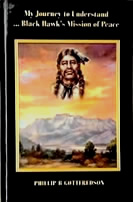 Mission of Peace is his detailed description of indigenous people and their deep sacred connection to each other and Mother Earth.
Phillip wrote, "When the world was created, Creator touched it with his hand, and so it is sacred and spiritual. The Land is our home, our mother, nourishing all her children. The Land is sacred and belongs to all who inhabit it."
"Native American culture is a perfect example of total spirituality without religion," is a familiar saying among Native people. "While living with the Shoshoni and several other Tribes, the Elders invited me to participate in numerous sacred ceremonies. It was life-changing. The spiritual experiences I had profoundly changed my understanding of Native American culture, and opened my eyes to the sacred responsibility we have with Mother Earth," said Phillip. Understanding Native culture and time-honored traditions is essential when establishing meaningful relations with Indigenous peoples, especially for educators with Indigenous students in their classrooms.
Honesty, love, courage, truth, wisdom, humility, and respect are ancient traditional virtues and values that Black Hawk and indigenous people have honored throughout their history. See Native American ethics and protocols.
Simply put, scholars ignore that the age-old message of Indigenous America is about 'connection, 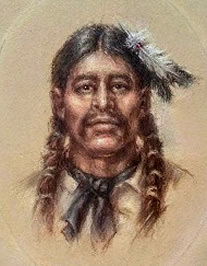 relationship, and unity.' All people are one. All are the direct living descendants of our Creator. Lakota Chief Joseph said, 'We have no qualms about color. It doesn't mean anything." After decades of exhaustive research, Phillip Gottfredson wrote, "there can be no doubt that this was Chief Black Hawk's message when he made his last ride home to pass out of this world in peace." He was in severe pain, dying from a gunshot wound to his stomach at the Gravely Ford Battle. In the final hours of his life, Chief Black Hawk made a painful hundred-and-eighty-mile journey by horseback from Cedar City in southern Utah to Payson. He advocated for peace and an end to the bloodshed. This heroic journey was Black Hawk's 'mission of peace.' Still, colonialists were too arrogant to see what it means to be human. Chief Black Hawk died on September 26, 1870. He was buried at Spring Lake, Utah.
There is much we can learn from First Nation people if only we would get out of our heads, and listen with our hearts. We  need to help each other. We are all interconnected and interdependent upon one another. We need each other to survive and live. We need each other as equals. We are all in a relationship with each other. And each becomes a relative by relationship. We need to help each other learn the truth, and heal from over a century of fake history. We need to find a pathway to forgiveness and help to build that bridge between our cultures with compassion, honesty, and mutual respect for humanity. See We Can Forgive, but never forget.
"I see a time of seven generations when all the colors of mankind will gather under the sacred tree of life, and the whole earth will become one circle again." -Chief Crazy Horse, Oglala Lakota.
"How do I know these things? I lived with them for over 25 years; I found  the truth. These are traditional teachings of the Timpanogos I learned while living with them and Native Americans throughout North America, and the Mayan in South America. I am proud to say I voluntarily and willingly assimilated into Native American culture, without shame or regrets. It has been the best years of my life. History is not just the study of the past; it's also the ethnology of indigenous people, present traditions, rituals, and legacies. But it's not about me, it's not about you. It's about all of us, the human race, the circle of life. I'm only the messenger," said Mr. Gottfredson. ~
See Utah Black Hawk War Veterans
This Months Featured Topics
April 12, 1863 Little Soldier bravely attacks Gen. Connors outfit
April 9, 1865 Manti John Lowry triggers Black Hawk War
April 10, 1865 Barney Ward and Peter Ludvigson killed.
April 21, 1866 The Circleville Massacre


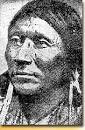 This is NOT Timpanogos war Chief Black Hawk, aka "Antonga."