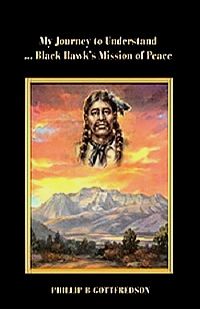
In Remembrance |
SPRING LAKE 1870 There were many great leaders of the Ute Nation, but few left behind a legacy as memorable as that of Chief Noonch "Black Hawk." Noonch was a man of great character and a brilliant leader. While historians have unjustly villanized the man still
sufficient evidence reveals that he remained true to his altruistic views, as he was a champion of peace to the day he died. 1869-70 in a letter written by William Probert to my g-grandfather Peter Gottfredson,
Probert makes reference to Black Hawk's "Mission of Peace." In spite of the tremendous personal agony that Noonch endured throughout his life from the time he was a child, in the remaining weeks before his death he was physically distraught, gaunt, hollow-eyed, skeleton like; yet he elected to travel by horseback nearly two hundred miles from Cedar City to Springville, Utah. Black Hawk was under heavy guard, and accompanied by his devoted brother Mountain and friend Joe, Along the way they stopped at every Mormon settlement and with dignity Noonch reminded the settlers they have broken their promises and stolen his peoples land and brought disease. Yet he asked the Saints to forgive him and his people for the sufferings they had caused them, and admonished them to do the same and end the bloodshed. He was well received, and left a lasting impression on the saints, albeit some took his "Mission of Peace" as a surrender. If he surrendered, it was to his own heart. If he surrendered it was to save the few remaining lives of his people.
A LETTER FROM WILLIAM PROBERT Dated at Provo, Utah, July 1st, 1915Mr. Peter Gottfredson, Springville, Utah Dear Sir:--I am glad to comply with your request to give some items of history of some of the Indian troubles in and near Round Valley (Scipio) and in the following narrative I am sure some of the erroneous stories told in regard to the death of Black Hawk, the great Indian Chief, and also Panacara, an inoffensive Indian who made his home in Round Valley, may be corrected and the truth of the matter given to the people in your proposed history of the Indian troubles of early Utah days.
There are probably a dozen men in Utah who claim the honor of killing Black Hawk, none of which is true. It is true that Black Hawk was severely wounded in the fight at Gravelly Ford on the Sevier River, near what is now called Vermillion; but he lived three of four years after receiving the wound; and before his death Black Hawk obtained permission from the military authorities of the Territory to visit all the places where he and his tribe had caused trouble or raided. And accompanied by a few (seven or eight) warriors, Black Hawk visited every town and village from Cedar City on the south to Payson on the north and made peace with the people. On his mission of peace he was provided with an escort, usually from two to six citizens, from town to town. Ansel P. Harmon and myself acted as such escort from Holden to Scipio, Millard County. Black Hawk told the people wherever he went that he was going home to die and before the end came he desired to be at peace with the pale faces. Black Hawk died at his wigwam near Spring Lake in 1869 or 1870; the exact date I am unable to give. He was buried in the foothills immediately east and south of Spring Lake Villa, Utah County. Because of the killing of the old man Ivie (James Ivie) in Round Valley (Scipio) a few years before by members of the Black Hawk tribe it was feared that the old warrior would be harshly treated by the Ivie family on the trip through the valley, unless provisions were made in advance for his protection from assault from that source. The Ivies had previously sworn vengeance, and some time before Black Hawk's appearance on his mission of peace, the old Indian, Panacara, had been shot to death by James A. Ivie. In order to justify himself, Ivie charged that Panacara was a spy for the Ute Indians on the south, which was not true, as Panacara was a special friend of the white people in that vicinity and was hated by the Utes. On one occasion a band of Utes came into the valley for the soul purpose of killing him. Panacara was for a number of years before his death medicine man for the Pahvante tribe of Indians was always friendly with the white settlers. Panacara's death at the hands of Ivie was brought about in this way: The old Indian came to the town of Scipio, and was objected to by the military authorities and a rule was adopted that Indians should not carry arms when visiting the settlements. Accordingly the acting justice of the peace Benj. Johnson, prevailed upon the old Indian to give up his gun. The Indian willingly gave the gun the justice and started out to cross the hills in the direction of Oak Creek, when Ivie followed him, and shot him dead. He was buried where he was killed. According to Indian custom it was a life for a life and it did not matter to them who it was just so they got their revenge by killing a white. For the death of Panacara I came nearly losing my scalp at the hands of Nun-ka-tots (a particular friend of Panacara), who lived most of the time with him. I was on my way from Deseret to Scipio with a load of wheat and on reaching a point on the desert near Mud-Lake the reflection of a gun showed an Indian in hiding behind a mound near the road. I jumped off the wagon, ready with my rifle for action when the Indian rode away. For seven years this Indian avoided me and finally came to me and asked if I was tobuck now. I told him I was not tobuck and he said me no tobuck; and from then on this Indian and myself were good friends. ("tobuck" means "angry") (Signed) William Probert. Manti, Utah, Feb. 12,1915. Box 109.
If the Indians Had Been True To The Mormons"That if the Indians were true to the Mormons and would help them against their enemies, then the Mormons would always keep them from want and sickness and give them guns and ammunition to hunt and kill game with, and would also help the Indians against their enemies when they went to war. This talk pleased the Indians, and they agreed to all that I asked." John D. Lee

Mormon baptism of the Shivwits Indian Utah
"If the inhabitants of this
Territory, my brethren, had never condescended to reduce themselves to the
practices of the Indians, to their low, degraded condition, and in some
cases even lower, there never would have been any trouble between us and our
red neighbors. Treat them kindly, and treat them as Indians, and not as your
equals." -Brigham Young 1854
I say if only the Mormons
would have accepted the Indian culture on their own terms, and not forced
their religious beliefs upon them, and had they not demoralized them by
looking down their noses at an ancient that culture that had thrived and
flourished for centuries of time. Had they not massacred hundreds of
innocent lives because they were Indian. Had they not segregated them on
desolate reservations and plundered their land, perhaps things would have
turned out different.
As I continue to learn from
the Native people what it means to be an Indian, I am still shocked and
disgusted by the injustices and discrimination that they face each and every
day not only from the general populace of Utah but the state and federal
government. I am sickened every time I have heard "we have given the Ute
every chance to succeed, yet they choose to live off the government, and
live in poverty." What kind of choice have they been given? To conform to
white man's beliefs or walk knee deep in the blood of their people? To give
up their land, children, culture, traditions or die?
The arrogance and attitudes of supremacy toward the Utah Indian people has
prevailed for 150 years unchallenged, and few have had the courage to stand
up and say, enough, we're not going to tolerate these human injustices or
knowingly participate in genocide of the American Indian people. I am
astonished that they have had little or no voice, ignored, shunned, kept out
on the fringes of society and denied access to even most the basic
fundamentals of equality and human rights. That they live in fear of telling
their story, their truth, that there may be retribution for exercising their
freedom of speech.
Since Columbus there has been conflict between the Native American Indian and European settlers, what makes Mormon relations with the Native people an anomaly in American history is that founder and polygamist Joseph Smith evangelized that the American Indian were a chosen people whose roots began in the middle east. And that the church had a divine obligation to convert the Native American Indian culture to Mormonism according to Church doctrine, and in so doing the "loathsome" Indians would become a "white and delightsome people," and would be forgiven of the sins of their forefathers. (Book of Mormon 2 Nephi 5:21-23) According to church doctrine, the nature of the dark skin was a curse, the cause was the Lord, the reason was because the Lamanites "had hardened their hearts against him, (God)" and the purpose was to make them "loathsome" unto God's people who had white skins.
The exact birth date of Black Hawk is not known. He was born
at Spring Lake about 1837. His family bloodline reveals a long line of
legendary leaders dating back to the early 1600's. Chief Sanpete, Chief
Sanpitch, Chief Wah-kara, Chief Tabby, Chief Tabiona, and Chief Arropeen,
are just some of Black Hawk's relatives.
Black Hawk is not a Ute name, it is a name Brigham Young
dubbed him with. His Ute name was Noonch. The Ute call themselves Noonchee,
and he was named in honor of his people.
Noonch was groomed from his childhood to be a leader of his
people. Not only would he need to master the skills of a warrior, as with
any leader he would need to exemplify the altruistic views of his community.
Respect, honesty, truth, wisdom, kindness, integrity, and courage were the
basic beliefs of the Native people.
Conflicts began in 1849 between Mormon
settlers and the Ute, and in April of 1865 the Sanpete war (later became
known as the Black Hawk War) had begun in Manti, and had quickly spread
throughout Utah territory. While Mormon settlers had pushed their way into
the most prime land of the Ute claiming it as their own, since 1849-50 the
Ute had been subjected to 84 bloody confrontations, resulting in
approximately 500 deaths, loss of land, and the depletion of their natural
food supply. Adding to this disease had spread epidemically among the
Indians, resulting in thousands of more deaths.
On August 12, 1867, Superintendent Head was on his way to the Uinta Reservation when he
met with Black Hawk. It was here that Black Hawk and Head had a talk, and Black Hawk told Head that he and his men were tired of fighting and wanted peace. As the two men talked, Head asked Black Hawk how many men were in his band and Black Hawk said to Head he never had more than 100 men under his control, but that he had 28 lodges under him, but that he was assisted by 3 other chiefs who had between 10 and 12 lodges under their control. Black Hawk explained that while his lodges looked to him as their chief, he answered to the other chiefs over the other lodges. He further explained he had no control over the other chiefs and their lodges.
The Ute were in a desperate situation, as immigrant setters were pouring in
to Utah at the rate of 3000 a month. By 1867 white population had reached
around 80,000, more than double that of the Ute.
Tabby was the leader of the Ute tribe since the time when negotiations for
peace had broke down at Manti. While his brother Black Hawk had been the War
Chief on the front lines of the war, trying desperately to re-claim and hold
on to the ever diminishing land of the Ute.
The previous year of 1866 was the worst time for both the Ute and the Mormon
settlers. Battles were raging in every direction. Black Hawk had already
witnessed the murder of his family, and the beheading of his kin at Fort
Utah. Then in the mid part of the same year, Brigham’s botched plan to take
Black Hawk’s father captive in a ploy to lure the war chief into a trap, Sanpitch managed to escape only to be hunted down and murdered, much to the
dismay of Brigham. For Sanpitch had long been an advocate for peace and it
was not Brigham’s intention that he be killed. This was a devastating blow
to Black Hawk’s family, and was when Tabby vowed to join up with his brothers
Mountain and Black Hawk and avenge the death of their father.
However, Black Hawk had been severely wounded while in battle at Gravely
Ford just a few days before, and his brother Mountain then was wounded in
battle at Diamond Fork, near Spanish Fork.
A turn of events brought about by Black Hawk then began, when within a month
after he had been wounded, Canute Peterson, bishop of Ephriam, he and his
wife took food, medicine, tobacco, and clothing to the ailing Chief. Soon
after, Black Hawk and several of his warriors visited Canute in Ephriam, and
after enjoying a feast with the towns people there, Black Hawk and his
friend Canute smoked the peace pipe and vowed that their friendship would
last forever.
Following this event, August 12, 1866 Black Hawk had asked Indian
Superintendent Franklin Head to meet with him while enroot to Tabby’s camp
near Heber. On the 13th the two spoke for some time when Black Hawk told
Franklin that he and his warriors wanted peace, they were tired of the
bloodshed. When Franklin asked the Chief if he was sincere, Black Hawk
handed Franklin his knife and told Franklin to cut off his hair, thus
demonstrating his sincerity.
On August 14th Tabby was in the process of preparing for more war when Black
Hawk convinced him that it would be better to end the fighting in the best
interest of their people. In other words they knew they were fighting a
losing battle.
Both Tabby and Black Hawk then set out to bring about peace. Tabby made
peace with the residents of Heber. Black Hawk returned to Cedar City and
spoke with his warriors along the way encouraging them to stop fighting. For
the next nearly four years that followed Black Hawk kept his word and
campaigned for peace. By the time he was in Cedar City, he knew he was going
to die. For he had not recovered from the wound he received at Gravely Ford,
and he had contracted tuberculoses. Gaunt, hollowed eyed, a mere skeleton,
Black Hawk along with his brother Mountain and several of his warriors began
a long trip back to Spring Lake were he was born, and where he would die.
The two hundred mile journey took more than a week by horseback. And along
the way Black Hawk met with Mormon settlements. He spoke at meetings in
their churches, and in public squares. He reminded them that they had taken
away his people’s land, spread diseases, shed their blood, caused them to
starve, and broken their promises. But then he asked them to forgive he and
his warriors for the trouble they had caused, and asked them to do the same,
and end the bloodshed. He made a lasting impression on the Mormons, and this
would become known as Black Hawk’s “Mission of Peace.”
From the time Black Hawk had promised Franklin Head that he would end the
war, while skirmishes continued off and on, the war decreased dramatically
through the years 1867-70. Black Hawk died and was buried with honors at
Spring Lake in 1870.
The peace negotiation between Joseph Murdock and Chief Tabby at Heber should
be remembered as the first in a series of peace negotiations that followed
Tabby and Black Hawk’s decision to end the war. It also demonstrates the
humanity of both cultures willingness to co-exist peacefully, and reconcile
the past. But for the Ute there was much more at stake, for it was a matter
of self-preservation, as only a few thousand were left out of a population
that before numbered in the tens of thousands. Peace negotiations took place
on August 20, 1867, eight days after Tabby and Black Hawk met.
Joseph Murdock’s long time standing with the Ute, and in particular with
Tabby, because of his friendship this gave Tabby the confidence to enter
into a peace agreement. But to make the claim that the treaty led to the
conclusion of the war can’t be substantiated based upon the fact that Black
Hawk had previously convinced Tabby to stop the war, and the two set out
over the following four years to bring about peace.
Remember, the troubles didn’t end for the Ute, they were then rounded up and
forced to live on the reservation, exiled from their home. By 1919 their
population of 40 to 70 thousand had deceased to just 2400. It was the most
devastating event in the Ute’s 600 year history.
Requesting that Head cut his hair off is astonishing, but clearly depicts
Black Hawk as a compassionate and a brilliant tactical leader. To understand this we need to examine closer the cultural beliefs of the Utah Indian to appreciate why Black Hawk would ask Superintendent Head to cut off his hair to symbolically demonstrate his sincerity in wanting peace.
Long hair for the American Indian is a tradition as old as time. Ask a Native Indian the significance of having long hair and you will get a broad range of answers, all of which point to a common thread, having long hair is synonymous with being Indian. There is simultaneously an association with spirituality and long hair, that it takes time to achieve spiritual enlightenment through patience, so it does with growing hair long. When a person they love dies cutting their hair is an ultimate expression of showing respect for that person. The list is long that describes the significance of having long hair, every reason is related to spiritual, sentimental, and even personal empowerment. For Black Hawk to ask Head to cut off his long hair was the ultimate expression of humility and personal integrity, underscoring his sincerity, personal sacrifice and commitment to foster peace.
The news spread fast and as Brigham Young took credit for having reconciled the war through vigilance and kindness underscoring his policy “to feed them and not fight them” had paid off. The Denver Rocky Mountain News quoted Brigham saying, "You can kill more Indians with a sack of flour than you can with a keg of powder." As he continued to boast of his victory he said, “if you want to get rid of the Indians, try to civilize them.” But there is no question Brigham and Church authorities were exasperated over the past events, and especially when Brigham’s plan to take and hold Sanpitch as ransom to lure Black Hawk into his web of deceit had failed miserably. Brigham had to concede, regarding his own people, that the “Architects of Zion” had to “work with such material as the Lord has provided, stupidity, wooden shoes, and cork brains thrown into the bargain.” The following account from a rather obscure book titled History of Springville by Finely gives insight to the meetings with Black Hawk and the people in the towns he visited. Regarding his "Mission of Peace" the writer states that this conference was the one that "ended the war" which shall be disregarded as misinformed, still the account is insightful just the same. "Several Springville lads surprised to find themselves eye-witnesses to the important conference which ended the Black Hawk War. These boys were playing in the corn field just back of Stewart's Grove just west of town. In this grove U.S. Officers and General Marrow met the Indian chiefs in a large tent owned by the white men. The officers were seated in the tent when the Indians came riding out of Maple Canyon to join them. The braves were all painted up and bedecked with beads and feathers. The head chief and several sub-chiefs dismounted and were escorted to the tent where the white officers were seated. The other Indians remained on their horses. As soon as those authorized to take part in the council were all inside, the tent flap was dropped so that those outside could not see what was going on inside. The small lads in the cornfield, however, were more fortunate. The back of the tent was left up a little and the boys, by lying low in the corn, could see and hear what was going on. The simple sincerity and Native dignity of Chief Black Hawk who led in the ceremonies made a lasting impression upon the boys. Black Hawk took a long stemmed pipe, the pipe of peace, and offered it first to Brigham Young, the chief spokesman for the white men. The white man waived the pipe back to chief to be smoked by him. The chief the lighted the pipe and drew a long breath from it, and facing the east expelled the smoke slowly. Another breath was inhaled as the chief turned to the west and blew the smoke in that direction. The same was repeated toward the north and the south. Then the smoke was blown up toward the sky and lastly down toward the earth. This was his pledge for peace on all sides and in every direction. When he had completed this ceremony, he carefully wiped the stem the end of stem with his blanket and passed the pipe again to Brigham Young who went through the same ceremony as did all the others in their turn. Then all shook hands heartily thus completing the treaty of peace. The Indians then mounted their horses and rode back to the canyon.
There were three treaties signed over a four year period. None were ratified. None of them were legal for only the federal government had the authority to make treaties on behalf of the Indian people.
These were only agreements. The first was signed 1868 in Strawberry Valley
(Heber). Present were Superintendent of Indian Affairs Colonel Head, with sub chiefs of Black Hawk and Chief Black Hawk. This peace treaty with the Ute Indians was finalized and signed in Bishop William Seely's house on Main Street in 1872 at Mount Pleasant. "On September 17, 1872 , General Marrow, Apostle Orson Hyde, Bishop William Seely, Bishop Amasa Tucker, Bishop Frederick Olsen, Colonel Reddick N. Allred and others met a number of chiefs who had been present at the former council (Springville, Utah August 17, 1872). Among these were Tabiona, Angizeble, White Hare, and some who were known to have encouraged, if they had not taken part in the depredatory incursions; all entered into a treaty of peace, and it was believed that the principal danger of a war was passed." - Peter Gottfredson Indian Depredations in Utah. The third treaty signed was in 1873 at Grass Valley. Present were Peter Gottfredson, A. K. Thurber, William Jex, George W. Bean, Bishop A. Halladay, William Pace, George Evans, and Chief Tabiona. (See Treaties click here) The Utes were then driven onto reservations. In such a short time their world had been turned upside down. The once majestic society that had prospered for ten thousand years, now their life as they had known it was turned into rubble in an instant. Leavening their home behind, the deer were gone, the fish were gone, and the streams polluted. Treaties were broken at will by the whites, all that was left for the Natives was a tract of land that Brigham Young and the U.S. Government had set aside which was desert, unfit for any man to live upon. Still some skirmishes continued as a few remaining Natives continued to fight until 1872.
Ute Leader Chief Black Hawk Dies"We can look back and see where we could have done better, but would we." John Lowry, the one who is given credit for triggering the war between the Ute and the saints when he jerked Chief Arapeen from his horse on that day in Manti, said, "It was a question of supremacy between the white man and the Indian. We had to do these things or be run over by them." In all honesty reader, who "ran over" who? The Mormons entered the Ute territory in 1847. They, the Utes, declared war in 1865. According to my calculations eighteen years had passed before the Ute declared war on the saints. By 1865 over 500 Native Ute Indians had been killed by the hands of the saints, but this figure does not include the untold number of deaths from measles, smallpox, tuberculosis, and murder during these 18 years. And it does not account for the numbers who had died from starvation. Black Hawk was one of the great leaders of the time. But where is the monument or the memorial to recognize the greatness of Black Hawk for his leadership, and the tremendous contribution the Ute have made to Utah and America?
The Transcontinental Railroad had been completed May 10, 1869 sealing the fate of the Ute people into the territory having an even greater impact on the Natives land. "The Utes must go" and over 1400 Utes were rounded up from the Ouray tribe and led by gun point to White Rock in northeastern Utah. A trek made mostly by foot, the Ute who occupied the mountains were forced onto a desert. The Assimilation program enacted by the government in 1887 provided the Native people give up their way of life and become farmers; their children were taken away and forced into boarding house schools. Many of these children were prevented from seeing their families for a period of six years. There many died from disease and were cremated or buried on the boarding school property. Quoting from an essay written in 2002 by Daniel McCool, Professor of Political Science at the University of Utah, he said the following in and article he wrote titled "Utah & the Ute Tribe Are At War." "It all began with Abraham Lincoln and a promise. In the midst of history's greatest test of presidential mettle, Lincoln took time in 1861 to establish the Uinta Valley Reservation for the Ute Indians in Utah. Before he wrote the order, however, the federal government asked Mormon leader Brigham Young if the Uinta Valley was appropriate for a reservation. Young reported that the land was so "utterly useless the the only purpose was to hold the other parts of world together." In other words, it was perfect for an Indian reservation." October 17, 1872, Chief Wandrodes, Antero, Tabiona, and Kanosh accompanied by Judge George W. Bean of Provo as interpreter, Left Salt Lake City with Special Agent Dodge to confer with the "Great Father" at Washington. The purpose of the Ute leaders for going to Washington was to ask for the governments intervention and assistance. They were well received but did little to bring justice for the Native people."- Indian Depredations in Utah Peter Gottfredson.
Daniel Miller Dies From Gunshot WoundsIndian Depredations in UtahSpring City Sawmill September 26, 1872 Peter Gottfredson witnessed the Last Man killed in the Indian Wars of Utah was Daniel Miller of Nephi, Juab County. The tragedy took place on the morning of the 26 of September, 1872, at Snow and Douglas saw mill, in Oak Creek Canyon, Sanpete County, three miles east of Spring City. Peter held Daniel in his arms and asked, "do you want us to take revenge on the Indians?" Daniel replied, "No, they don't know better. Then the poor fellow died." - Peter Gottfredson Indian Depredations in Utah (See Daniel Miller .) Peter had witnessed the passing of so many of his friends both Indian and white. His heart in turmoil and deeply saddened by all that had happened. In the mid 1890's Peter began his twenty year long endeavor to record the history of the war saying, "What information we get first handed must of necessity be obtained now or never." Taylor Thurber a life long friend of peter said, "He has spent 20 years of his life, the best years of his life, in compiling an authentic history of the Indian Depredations in the State of Utah. It is a book that will go down through the ages because of the close contacts he has made. Just think of man without an education to undertake and write a book! It must have been a tremendous impulse behind this man. He had no wealth, he was one of the last of the pioneers. It was a gigantic task, and there must have been a will to do a thing of that sort. And there is no more pleasant record. His greatest interest was in labor, in services that would not bring to him anything. But he was interested in the things he was doing. He was a busy man and the men who think of Peter Gottfredson are the men who think of the grandness of his character. But the things that he has done will grow as the years pass." Peter wrote these words, "It is fitting, very fitting, as it were, for individuals to take a inventory of themselves. Of this earth's activities and to see whether or not it was worth while to live in accordance with the plan of living, and to think about the life to come. I can look back and see the mistakes I have made, also the successes. In my minds eye I can see where I could have done better, but would I. We can look back and see where we could have done better, but would we. Environments have much to do with shaping our natures character and destiny. Had we at certain stage in life taken a different course it is impossible to know where it would ultimately have led to. So I say, it is no use to harbor regrets, but necessary to make the best of the future. Life is a stream leading to somewhere. I have often in my minds eye compared it with starting out on a highway with many roads leading off in different directions, each leading to a different place and in each place conditions differ, as do the people with whom we would associate. Which would affect our condition in life, physically, morally and intellectually, and who shall say which would have been the best road for us to have followed; and here we are, so I say, and advice; try to so live each day that there will be no regrets."


Disgracefully Black Hawk's Remains Exhumed!The relations between the Ute and the Church was morally suspect at best. Imagine, if you will, having the corpse of your grandfather disrespectfully unearthed by church members, then for some strange reason put on public display
in the window of a hardware store in downtown Spanish Fork, Utah, and later in the Church museum on Temple Square as a curiosity. I personally remember seeing
Black Hawk's remains on display there at Temple Square when I was just a young boy. The family of Black Hawk had no legal or political recourse until 86 years later. In 1996 under the protection of federal law, the family of Ute leader Chief Black Hawk were at last able to rescue his bones from a storage box in a basement room at BYU and rebury their beloved grandfather at Spring Lake, Utah. Gratitude goes to a young Boy Scout
Shane Armstrong who in 1993 elected to earn his Eagle Badge by getting Black Hawk registered with the Forest Service NAGPRA. For a time no one could locate his remains, according to news paper articles. "I thought it was weird that no one had records on him," the young Scout remarked to reporters. So I say that to judge the Indian as "loathsome" is simply hypocritical. Turn it around, if this happened to anyone of our former Church leaders or beloved family members, would there be anger? Would you feel demoralized? Would you perhaps feel rage? Suppose all your anger fell upon deaf ears and you were told there is nothing you can do about it? (see NAGPRA Examination of the Physical Remains of Black Hawk)

Burial Place of Noonch "Black Hawk" Located at Spring Lake Between Payson and Santiquin, Utah
|