BLACKHAWKPRODUCTIONS.COM

Advocate for Equality for the Utah Native Peoples  ~ Online Since 2002 ~

HOME

Forums

 How can I help...

Bookstore

Contact


Burial site of Chief Black Hawk


“GRANDFATHER”

once again, you return home to this valley you roamed

“in peace”. These valleys were plentiful with food, water. These mountains 

were home to you as well. You see your home as you rest. Your long journey at last

fulfilled as you return back to mother earth rest in peace

Grandfather.


Menu:Black Hawk's StoryGottfredson Files Commentary & Perspective  Research & MusesNative WaysBHP Theater News Alerts


Grave Robbing in Utah is a Cultural Tradition

Wednesday, June 17, 2009
by Phillip B Gottfredson


"It's time now for Indian people to stop being victims, to stop allowing themselves to be victimized." - Forrest Cuch Division of Indian Affairs

"Why should a man loose his life over trash and trinkets." - a spokesman for Blanding told a Channel 2 News reporter.

FBI agents after years of undercover work arrested a couple dozen grave robbers. Among those charged was Dr. James Redd who was the local physician in the town of Blanding, along with his wife Jeanne Redd on June 10, 2009. The following day Dr. Redd was found dead on his own property from apparent suicide, according to the Salt Lake Tribune. This was Redd's second run in with the law over grave robbing.

Arrogance didn't end with the Black Hawk War in 1870. Imagine, if you will, having the corpse of your father disrespectfully unearthed by grave robbers; then for some strange reason put on public display in the LDS Church museum on Temple Square as a mere curiosity.

Even though the Graves Protection Act was passed in 1906, Black Hawk's remains were unearthed by Mormon looters in 1911, just 41 years following his death. And for two years were placed in the window of a co-op store in downtown Spanish Fork; afterwards taken to the LDS Church museum on Temple Square in Salt Lake City.

Was the reason simply amusement for others, was grave robbing for art, pleasure, punishment, a morbid fascination of death, divine obligation, or most importantly, the wielding of power?

Oh yes, I vividly recall seeing the display in the museum as a boy as do countless others, and no doubt someone reading this remembers as well. For the skeletal remains of Black Hawk remained there for nearly 70 years, and all the while his living descendants bore the agony, and humiliation - unable to convince the church to give up the remains of their beloved grandfather.

Since the time in 1850 when Church apostle George Albert Smith told the Mormon legislature that "the Indian have no right to there land" get rid of them, our Native people have been the victims of thievery. Their land was not bought, or traded for, it was stolen, as was their culture, and their inheritance, heritage, grave-sites, and their dignity as human beings. History accounts repeatedly shame Utah's First People as being "thieves" and "loathsome" is just simply hypocrisy and racism at it's worst. 

But why? Where did this mindset of supremacy come from?

Brigham Young in a speech delivered in the Tabernacle, Great Salt Lake City, April 6, 1854: "If the inhabitants of this Territory, my brethren, had never condescended to reduce themselves to the practices of the Indians, to their low, degraded condition, and in some cases even lower, there never would have been any trouble between us and our red neighbors. Treat them kindly, and treat them as Indians, and not as your equals."

In the year Black Hawk's remains were dug up by Bishop Ben Bullock and Lars Croft, Heber J. Grant was president of the Church of Jesus Christ of Latter-day Saints. Followed by George Albert Smith (1945-1951); David O. McKay (1951-1970); Joseph Fielding Smith (1970-1972); Harold B. Lee (1972-1973); Spencer W. Kimball (1973-1985); and Ezra Taft Benson (1985-1994). These prophets have administered the affairs of the Church from Church headquarters in Salt Lake City. These men presided over "Gods Church" as the "mouth piece of God," but for some reason never had enough respect, or compassion toward their fellow man to give up their claim to the bones of Black Hawk or even show slightest compassion for his living descendants.

The family of Nooch "Black Hawk" had no legal or political recourse until 86 years after his grave was robbed. In 1996 under the protection of the Native American Graves Protection Reparation Act (NAGPRA) enacted by then president George Bush Sr., the family of Ute leader Chief Nooch "Black Hawk" were at last able to rescue his remains. With the help of Charmain Thompson, archaeologist for the National Forest Service, his bones were found in a storage box in a basement room at BYU. Gratitude and credit goes to the humanitarian efforts of a young Boy Scout Shane Armstrong who in 1993 elected to earn his Eagle Badge by getting Black Hawk registered with the National Forest Service NAGPRA. For weeks no one could locate his remains, according to news paper articles. "I thought it was weird that no one had records on him," the young Scout remarked to reporters.

The tradition of exhibiting native Indian remains in Western societies has existed since the earliest encounters between Europeans, and indigenous populations. Exhibiting non-white bodies as a popular practice reached its peak in the nineteenth century in both Europe and in USA. The exhibition of native peoples for public entertainment in circuses, zoos, and museums became fairly common. In the USA, in particular, the spectacle of "freaks," "natives," and "savages" became a profitable industry at this time, as in popular traveling shows like Buffalo Bill's Wild West Show and Barnum and Bailey's Circus. World Expositions were also popular for the display of native bodies. Dissected and embalmed remains of the "native" body, particularly the skulls, and sexual organs, were also publicly exhibited.


The following was copied verbatim from the Deseret Evening newspaper article I located at the Harold B. Lee Library on BYU campus. The Church of Jesus Christ of Latter-day Saints owns the paper. Remember the Graves Protection Act was passed in 1906.

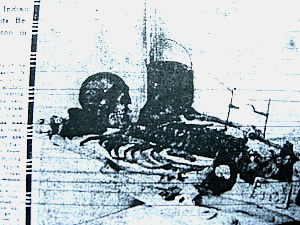
Deseret Eveing News Black Hawk on exhibit at LDS Museum

Grave looter William E Croft holding skull of Black Hawk.

Grave Looter William E. Croff

Holding the skull of Black Hawk


Deseret Evening News
Saturday September 20, 1919 Salt Lake City Utah

Bones of Black Hawk Indian Warrior
Now on Exhibition L. D. S. Museum


Benjamin Goddard Take Precaution to Verify Discovery of Grave of Indian Chief by Affidavits Before Placing Skeleton in Institution.

A case on the north side of the L.D.S. Church Museum is destined to become the center of to many a student of early-day Utah history. For resting peacefully in the midst of the very white settlers whom he loved to harass is all that remains of Chief Black Hawk who in the early sixties was dreaded and feared in many a town and settlement of Utah. What are described to be the bones of the Indian desperado have been brought from their final resting place near Spring Lake Villa, and now along with spurs, beads, sleighbells, ax, bucket, brass buttons and all such comforts which were supposed to accompany him to the Happy Hunting grounds are on display to the eyes of the White trespassers who he so much resented.

Before placing the skeleton on exhibit Benjamin Goddard, in charge of the museum, has made every possible effort to prove their authenticity and has obtained a mass of evidence which seems to prove unquestionably that none other than the famous chief reposes in the museum. Mr. Goddard has not only obtained the affidavits of those who exhumed the remains, but of early settlers near Spring Villa who knew the chief and saw his funeral cortege pass up the mountain a little to the east of the little Utah County town. There are also a number of interesting photographs showing the place where Black Hawk started on his last journey.

Severely Wounded

Utah historians and Black Hawk veterans declare that Chief Black Hawk died at Spring Lake Villa, a small settlement situated between Payson and Santiquin, Utah County, in 1870. The old Chief is declared to have been severely wounded in the fight at Gravely Ford on the Sevier River some three or four years before. He was assisting one of his wounded braves when sited by one of the settlers during the battle. The White man not being able to see the Chief shot through the horse which shielded him and wounded him severely. He still seems to have taken an active part bin the war on the white settlers after this mishap and actually before his death gained permission to visit every town and village from Cedar City on the south and Payson on the north to make peace with the people he had harassed. According to the stories told by Indian war veterans he had caused so much misery to the settlers during his raids on Utah towns and was so hate and feared that a number of heroes are declared to have arisen about the state who claim the honor of killing him. The old Chief, however, it seems, died in his wigwam near Spring Lake Villa and was buried in the nearby foothills immediately south and east.

The story of the Black Hawk War in Utah chiefly culled from the declarations of Black Hawk War veterans is one of the pitiful that stands taken by the Red men to save the land of their fathers from the inroads of the pale face. It was also the story of the heartbreaking fight of the early day settlers to establish their small home in the western wilderness.

Local historians declare the war started about 1864 when a small band of Indians camped near Gunnison, Sanpete County, had a siege of smallpox and began to blame the settlers for it threatening to kill them and steal their horses and cattle. Matters grew worse and worse and worse until Col. Reddick N. Allred and a company of cavalry started in pursuit of the Red men. Then came ambushcades) in the rugged foothills near Fish Lake and Grand river, depredations near Gunnison, Fairview, Spanish Fork canyon, Ephraim, Red Lake, Glenwood, Circleville, Pipe Springs, Salina, Moroni, Marysvale, Scipio, Thistle valley, Diamond, Fork, Lees ranch, Rock lake, Spring City, Warm Creek, the Indians attacking lonely settlers up and down the center of the state as far as St. George and even spreading their reign of terror over the Wasatch county.

Women and children were tortured, carried away, homes devastated, ranchers murdered, and all sorts of Indian deviltry committed under the leadership of Chief Black Hawk. This continued practically until the fall of 1873. when the Red men at last acknowledged the ruling hand of their White brothers. During this period various commanders in charge of local militia and federal troops took a hand in quieting the Red men and Brigham Young work earnestly to bring about some sort of a satisfactory adjustment between the warring tribes and the settlers.

Mr Goddard has painstakingly gathered the following information from old newspaper files and has supplemented the clippings with the affidavits of persons who know of this burial and finding the remains of the famous old Chief.

Account of Death

Black Hawk, the noted Indian chief was born at Spring Lake Villa, a few miles south of Payson in Utah county. Numerous accounts have been published of his death but from the files of The News it is evident that he died at his old home in Spring Lake, Sept. 26, 1870:
“Black Hawk”

October 5th, 1870

We received the following dispatch per the Deseret Telegraph Line: “Payson, September 27, Black Hawk died at the Indian camp, 3 miles south of here, last night. John Spencer, interpreter.”

From Spring Lake Villa, September 27, 1870, the following account reached The News:
“ten to tell you that Black Hawk the Indian, desperado is dead. He has been living here in camp with his brother “Mountain,” together with Joe and has been for several days. We knew he was sick but did not think of so sudden demise. This morning before sunup the Indian wail was heard in their camp, and soon was seen an Indian squaw with two horses heavily packed on their way to the foot of the mountains. Stopping at a small ravine within sight of our door, they killed one of the horses and proceeded to put away the body of the great Black Hawk. This is the place of his birth, and here he commenced his desperadoism and here he came back to die.

“Showone, a friendly Indian, the head of the camp about here, died at Goshen a few days since. “Quvant another good Indian lies in camp about ready to die. Really our Indian neighbors are fast passing away.

“Indian Joe, the present head of the Indians about here is here telling me about the death of Black Hawk. He wishes the Mormons to know that Black Hawk is now dead and that he died in his camp. B. F. Johnson.”

At the time B. F. Johnson was presiding elder and subsequently bishop at Spring Lake Villa, Utah county.
 

Makes Affidavit

The following statement also will be of great interest in this connection
Provo City, Utah, July 7th, 1919.

To Whom It May Concern;
The later part of September or first part of October 1870 my parents and their family were living in Spring Lake Villa, Utah county, state of Utah.

Several of us young people would visit the Indian camp on the north west of the little village and at this place “Old Black Hawk” was brought in a very sick condition. The Sunday before Black Hawk’s death, several of us young people visited the camp and heard him moaning and saw him lying on his bed. During the week he died, I, with others, stood on the main street of Spring Lake Villa, Utah, and saw old Black Hawk’s body tied across his horse in the funeral procession, there being about eight horses rode by Indians some in front of Black Hawk’s horse, and some following.

This procession followed a drag trail up the mountain a little east of south of Spring Lake Villa, to where his remains were buried. About one week later, several of the Indians came to our home – two of the squaws had their heads shaved, some of the Indians said they were Black Hawk’s squaws and their “heap big chief” was dead.
(Signed) Chana E. Hales
Signed in the presence of Ben H. Bullock.

Locate Grave

Some years ago Bishop B. H. Bullock of Provo and friends were in the vicinity of this old grave and felt the impressed to secure, if possible, the remains. After careful search they found the old resting place of Black Hawk; his remains were unearthed with what remained of his old bridle, especially the rosettes which were so well known to the settlers during the life time of the noted chief. The remains were carefully stored away for some time and later presented to the L.D.S. church museum on temple block.
More Affidavits
The following affidavits have also been added to the record:
Santiquin, Utah County, Utah, September 6th, 1919.

To Whom It May Concern.
During the year 1917 Bishop Ben Bullock was telling several men who were working at the Syndicate Mine on the mountain east of Santiquin, Utah, and a little east of south of Spring Lake Villa, Utah, that the remains of “Old Black Hawk,” Indian were buried some place near the tunnel that we were working in and one day while I was prospecting on the surface of the property I noticed in a slide of quartzite rock a piece that looked like the rock had been moved and a small mound built. I reported this to Bishop Bullock and then he with Lars Olsen and myself, started removing the rock and found the skeleton with beads, bridle, silver rosettes, spurs, saddle, sleigh bells, ax, bucket, cup, parts of a old soldier coat with buttons and several trinkets, among them a china pipe. Later it was reported by those that knew the Indian that we had found his grave and the things we had taken from the grave with the skeleton were “Old Black Hawk’s.” - William E. Croff.

Springville, Utah county, Utah
August 23, 1919
To Whom It May Concern:
In the fall of the year 1870 I was in Spanish Fork, Utah county, Utah, this being my place of residence at that time and “Old Black Hawk” the noted war Indian came to my home and I cooked the last meal he ate in Spanish Fork, Utah, before he died at Spring Lake Villa, Utah county, Utah. I remember his looks very well, his head and face were shaped more like that of a white man than an Indian, and his teeth were in very good condition.

I remember the silver rosettes, the bridle bit, his spurs, sleigh bells, and things in general that he had when coming among the white settlers before his death and bear testimony that the silver rosettes the bridle, bit, bells and spurs that Bishop Ben Bullock had in his possession were what I saw in the possession of “Old Black Hawk” and also testify that the skull and the teeth in the jaws of the skull are “Black Hawks.”
Louise N. Pace
Provo City, Utah
August 26, 1919

To Whom It May Concern:
In 1911 I became interested in what is known as the “Syndicate mine,” located on Santiquin mountain, a little southeast of Spring Lake Villa. Several of the old settlers of Spring Lake Villa knew the old “Black Hawk” has been on the mountain near where we was working this property. At my leisure moments I would hunt for the spot where “Black Hawk” was buried and one day one of the miners, William E. Croft reported what he supposed to be “Black Hawk’s” grave. This started an investigation and Mr. Croft along with Lars L. Olsen and myself uncovered the remains of “Black Hawk,” which were buried in a large quartzite slide. Three feet of rock were taken from the skeleton, and upon uncovering it, we found the remains ib a sitting posture. The first article we saw was a china pipe, which, was laying upon the top of his head. Then we discovered the saddle, the remains of the skeleton, portion’s of his horses bridle that had been buried with him; sleigh bells, ax, bucket, beads, part of an old soldier coat with the brass buttons still intact. All of these were removed very carefully, and for safety deposited them with the Spanish Fork Co-op where they were exhibited for several days.

Subsequently at the suggestion of Commander J. M. Westwood I secured these remains and conveyed them to the L.D.S. Church Museum on temple block, suggesting that they should be placed on exhibition there and preserved. – Ben H. Bullock.


I am personally acquainted with the descendents of Black Hawk, and in my conversations with them it is my understanding the LDS has never expressed any remorse to the family for their actions. And the land where Black Hawk's grave site is to this day owned by the LDS church. According to an attorney for NAGPRA, the actual gravesite is under the jurisdiction of NAGPRA.

The name "Black Hawk" is not a Ute name. It was a name Brigham Young in jest called him. So it became that Brigham being supercilious when eferring to him as 'Black Hawk' is the name by which he is now most commonly known. His Ute name was Nooch, and he was so named in honor of his people the Noochew.

Nooch was born into a noble family of legendary leaders spanning centuries of time. He fought bitterly. This noble man had to confront unimaginable horror as his people were dyeing from diseases and hunger, their homeland being invaded by foreigners, his family and kin were murdered. He faced challenges that were monumental for any leader of any peoples in any time. He should have given up, but something in his character wouldn't allow him to. Before Black Hawk died in 1870, deathly ill from a bullet wound he received a year earlier at Gravely Ford, he traveled 180 miles by horse and visited every Mormon village and apologize for the pain and suffering he and his warriors had caused. He asked for forgiveness and pleaded with the settlers to do the same and end the bloodshed. "You didn't see that happening on the part of the settlers", said Forrest Cuch, "So it took a greater man to do such a thing. And that's what is overlooked in the victors accounts."


EXAMINATION OF CHIEF BLACK HAWKS

PHYSICAL REMAINS

BY THE NAGPRA

1996

NAGPRA - The following was obtained by permission from the NAGPRA

[Federal Register: January 31, 1996 (Volume 61, Number 21)]
[Notices]
[Page 3459-3460]
From the Federal Register Online via GPO Access [wais.access.gpo.gov]

-----------------------------------------------------------------------

DEPARTMENT OF THE INTERIOR

National Park Service

Notice of Inventory Completion of Native American Human Remains
and Associated Funerary Objects From Spring Lake, Utah Under the
Control of the Uinta National Forest, United States Forest Service and
Currently in the Possession of the Museum of Peoples and Cultures,
Brigham Young University, Provo, UT

AGENCY: National Park Service

ACTION: Notice

-----------------------------------------------------------------------

Notice is hereby given in accordance with the provisions of the
Native American Graves Protection and Repatriation Act, 25 U.S.C. 3003
(d), of the completion of an inventory of human remains and associated
funerary objects under the control of the Uinta National Forest, United
States Forest Service, and currently in the possession of the Museum of
Peoples and Cultures, Brigham Young University, Provo, UT.
A detailed inventory and assessment of the human remains and
associated funerary objects was done by the U.S. Forest Service and the
Museum of Peoples and Culture's professional staff in consultation
with representatives of the Uintah-Ouray Ute Tribe.

The human remains--an adult male approximately 45-60 years old--and
a minimum of 13,558 associated objects were reportedly excavated by
local miners in 1917 from Forest Service lands above Spring Lake, UT.
The objects found with the remains include brass bells, an iron spur,
approximately 13,500 multi-colored glass seed beads, a metal axe head,
bridle rosettes, a metal bit, and copper bracelets.

The human remains and associated objects were accessions by the
Museum of Latter-Day Saints Church History in 1919. At that time, a
local physician attempted to confirm a report that the human remains
were those of the Timpanogots' chief Black Hawk who had died in 1870
and had been buried in the same approximate location. The physician
collected statements from Chana E. Hales, William E. Croft, Louise N.
Pace, and Ben H. Bullock who had known Black Hawk. These individuals
identified many of the objects as Black Hawk's personal effects.

The human remains and associated objects were curated by the Museum
of Latter-Day Saints Church History until 1994, when they were
transferred to the Museum of Peoples and Cultures for purposes of
inventory and repatriation. Ontological analysis confirmed the human
remains to be of a 45-60 year old male. Although Black Hawk's exact age
was unknown, reports from the era estimate his age as being in his
fifties at the time of his death. Many of the associated objects were
identified by representatives of the Uintah-Ouray Ute tribe as being
common in late nineteenth century Ute burials. No evidence contradicts
the identification of the human remains as those of Black Hawk.
Mr. Richard Mountain, Ms. Arlene Appah, and Ms. Silvia Cornpeach,
great-great grandchildren of Black Hawk's brother Mountain, have
claimed Black Hawk's remains and funerary objects on the basis of
lineal descent. On November 20, 1995, the Uintah-Ouray Ute Tribal
Business Committee passed a formal resolution recognizing their claim
and its consistency with Ute tribal kinship practice.

Based on the above mentioned information, officials of United
States Forest Service have determined that, pursuant to 43 CFR 10.2
(d)(1), the human remains listed above represent the physical remains
of Black Hawk, an individual of Native American ancestry. Museum
officials have also determined that, pursuant to 25 U.S.C. 3001 (3)(A),
the 13,558 objects listed above are reasonably believed to have been
placed with or near individual human remains at the time of death or
later as part of

[[Page 3460]]

the death rite or ceremony. Lastly, U.S. Forest Service officials have
determined that, pursuant to 43 CFR 10.2 (b)(1), Mr. Richard Mountain,
Ms. Arlene Appah, and Ms. Silvia Cornpeach can trace their ancestry
directly and without interruption by means of the traditional kinship
system of the Uintah-Ouray Ute tribe to the remains and associated
funerary objects of Black Hawk.

This notice has been sent to Mr. Richard Mountain, Ms. Arlene
Appah, Ms. Silvia Cornpeach, and officials of the Uintah-Ouray Ute
Tribe, the Skull Valley Executive Committee, the Southern Ute Tribe,
the Ute Mountain Ute Tribe, the Gosiute Indian Tribe, the Paiute Tribe
of Utah, and the Kaibab Paiute Tribe of Arizona. Any other individuals
that believe themselves to be lineal descendants of Black Hawk should
contact Ms. Charmaine Thompson, Heritage Program Leader, Uinta National
Forest, United States Forest Service, 88 West 100 North, Provo, UT
84601, telephone: (801) 342-5119, before March 1, 1996. Repatriation of
these human remains and associated funerary objects to Mr. Richard
Mountain, Ms. Arlene Appah, Ms. Silvia Cornpeach, may begin after that
date if no additional claimants come forward.

Dated: January 25, 1996.

Francis P. McManamon,
Departmental Consulting Archeologist
Chief, Archeology and Ethnography Program.
[FR Doc. 96-1827; Filed 1-30-96; 8:45 am]
BILLING CODE 4310-70-F
 

< />