
Excerpts from Indian Depredations In Utah
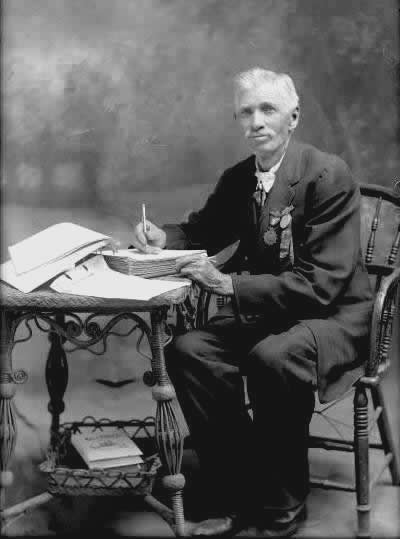
Courtesy of Phillip B Gottfredson, great- grandson of Peter Gottfredson

Peter Gottfredson's book Indian Depredations in Utah is one of the oldest firsthand accounts of Utah's Black Hawk War. Peter describes over hundred-fifty battles and massacres between the Church of Jesus Christ of Latter-Day Saints and the the Timpanogos Nation between the years 1847 to 1872. Early Mormon colonists stole their land and destroyed their culture over a twenty-one-year timeframe, which resulted in an astonishing 90% decrease in their population.
Peter was a friend of Chief Antonga Black Hawk and lived among the Timpanogos during the Black Hawk War in Pleasant Grove, Utah, to Provo, Springville, Spanish Fork, and throughout southern Utah to Cedar City. Peter lists the names of over six hundred participants in the wars, Timpanogos Chiefs and warriors, generals, troopers, and civilians. He also describes the battle sites from Utah, Cache, and Sanpete Counties, to Davis, Emery, and Wasatch Counties.
Note: Peter references both the Utes and the Timpanogos in his book, which is not to be confused with the Confederated Utes of Colorado, who were not in Utah until 1881, eight years after the Black Hawk War had ended. They are separate Tribes in language, bloodlines, and customs. Before the 1900s, the term "Ute" historically is used by Europeans as a blanket term when referring to any Native peoples of the Great Basin, ignoring their actual individual tribal affiliation. The word "Ute" is an Anglo term. European migrants and trappers coined the term "Ute." An acronym or slang of Shoshoni words at the time, i.e., yutahs, u-tah-ats, as is the name "Utah," which is a acronym of the Shoshoni word yutahs. Yutahs, pronounced "e utahs," refers to the reeds that grew around Utah Lake. The Timpanogos used the reeds to make arrows Etc. See: The Timpanogos-Ute Contradiction for more in-depth information.
Excerpts Topics Jump Menu:
Porter Rockwell Murders five Innocent Indians
FOUR MEN KILLED AT UINTAH SPRINGS, SANPETE COUNTY
SKIRMISH AT NEPHI, JUAB COUNTY. EIGHT INDIANS KILLED
THE BODIES OF JOSIAH CALL AND SAMUEL BROWN AT CHICKEN CREEK
MURDER OF A PEACEABLE INDIAN BY OFFICERS FROM CAMP FLOYD
RAID ON PINE VALLEY, INDIANS OVERTAKEN, ELEVEN KILLED
WM. J. ALLRED RECOVERS HIS HORSES
CHIEF TABBY SENDS WORD HE CAN NO LONGER CONTROL HIS INDIANS
DAN MILLER KILLED AND SON WOUNDED NEAR SPRING CITY
FOUR MEN KILLED AT UINTAH SPRINGS, SANPETE COUNTY
ATTACK AT SANTAQUIN, UTAH COUNTY. FERNEE L. TINDRELL KILLED
SKIRMISH AT NEPHI, JUAB COUNTY. EIGHT INDIANS KILLED
WM. MILLS AND JOHN E. WARNER KILLED AT MANTI, SANPETE COUNTY
CHASE'S SAWMILL IN SANPETE COUNTY BURNED BY INDIANS
THE ALLRED SETTLEMENT, (SPRING CITY) BURNED BY INDIANS
TREATY WITH CHIEF WALKER AND KANOSH. END OF UTE WAR
ATTACK ON WILLOW CEEEK, (MONA). ISAAC DUFFIN WOUNDED
AT PARLEY'S PARE, TWO MEN KILLED, ONE WOUNDED
Porter Rockwell Murders five Innocent Indians
March 5, 1851
"The pioneers of Tooele County had their compliment of trouble with the Indians, in common with the early settlers in Utah. "With them," writes the Historian Edward W. Tullidge for several years, the loss of cattle and horses was frequent and often severe. Scouting after the enemy, standing guard and forting up formed an important factor of their lives.
Many incidents of interest will remain unwritten, as only a few of the most important events can now be gathered up and placed on record. In the spring of 1851, some emigrants on their way to California were assisting Ezra T. Benson to put up a saw-mill at Richville, (now known as the Mill), when a party of the surrounding Indians stole their horses. One of them Mr. Ouster, with Harrison Severe, Thomas Lee and other " Mormon" settlers, followed them, as they supposed, to the west side of Rush Lake ; but evidently mistook the route the marauders had taken. However, they there found a band of Indians with their families, took thorn prisoners and started for Tooele, but without disarming the men.
On the way the Indians and consequently the guard became separated into small squads. It appears that Mr. Ouster was a little in the rear and south of the town of Tooele when the two or three Indians with him made a break in the darkness, for it was in the evening, and in the melee Ouster was shot. Those ahead of him soon learned the fact by his horse coining up with them riderless. Some men went back and found his body on a rock where he had fallen. The blood-stained rock was a witness of the event for many years. His body was taken to Salt Lake City for burial. This was the first bloodshed connected with Indian difficulties in the County. Harrison Severe, and perhaps others, succeeded in getting five Indian warriors into Tooele City to a military camp prepared by Captain Wright for their reception.
0. P. Rockwell, commonly known as Porter Rockwell, was sent from headquarters and took direction of affairs in this Indian trouble. Considering it best to make another effort to obtain the stolen horses, he took a party of men, and with them the five Indian prisoners and went through the mountains west of Grantsville into Skull Valley. The prisoners were evidently in sympathy with their thieving brethern and professed to know nothing of those who had stolen the horses. Their assertions received no credit from the whites. The party formed camp, went on a scout, and left Harrison Severe to guard the Indians for some twenty-four hours, rather a precarious business for one man under the circumstances.
Rockwell and his men, not finding any trace of the stolen horses, deemed it unwise to turn the thieves in their power loose to commit more depredations and perhaps shed the blood of some useful citizen, and they were sacrificed to the natural instincts of self-defense.
FOUR MEN KILLED AT UINTAH SPRINGS, SANPETE COUNTY
On September 30th, 1853, a party of four men, William Reed, James Nelson, William Luke and Thomas Clark, started from Manti, Sanpete County, with ox teams loaded with wheat for Salt Lake City. It was arranged that they were to camp the first night on the Sanpitch River, near where Moroni is now located, and wait there until a company with horse teams under the leadership of Isaac Morley should overtake them; then they were to travel slowly together through Salt Creek Canyon ; but contrary to arrangements they went on to Uintah Springs (now Fountain Green) and camped for the night. Early on the morning of October 1st their camp was attacked by Indians and all four men were killed. The savages had time in this instance to complete their fiendish work, mutilating the bodies of their victims to such a degree that when found they could scarcely be recognized.
When Morley 's company came along they found three of the bodies of the murdered men, but the body of Clark had been covered up in the wagon with wheat that the Indians had emptied out of the sacks which they had taken away with them.
SKIRMISH AT NEPHI, JUAB COUNTY EIGHT INDIANS KILLED
The company went on to Nephi at the mouth of Salt Creek Canyon, and on the morning of the 2nd of October (1853) encountered a camp of Indians and had a skirmish, in which eight Indians were killed and one squaw and two boys taken prisoners. When they reported in Utah County, a possee of about twenty men from Springville, Spanish Fork and Payson was organized under command of James T. Guyman. They went to the Uintah Springs and found the remains of Thomas Clark under the wheat in the wagon. He had been scalped, his head crushed and his body cut open and his heart taken out.
The posse went on to Manti and reported. They were accompanied by George Peacock from Springville who returned with the posse. At Manti they learned of the killing of William Mills and John Warner near Manti on the 4th. On their return the company stopped and buried the remains of Clark which was by then badly decomposed. It was said that George Peacock, who was a relative of Clark, got the body and buried it at Manti.
The particulars here given were obtained from Samuel T. Curtis of Salem, Utah County, who was one of the posse.
Copied from (Lights and Shadows of Mormonism) by J. F. Gibbs.
The attention of the traveler on the road from Deseret, Millard County, Utah to Nevada, will very likely be drawn toward a cedar post that occupies an unusual position a few rods north of the Sevier River, and a hundred feet from the east side of a shallow lake. The place, which covers about ten acres is about six miles west of Deseret, Millard County, Utah, with no habitation within several miles. The rough bark has been removed from the post, otherwise there is nothing in its appearance to attract attention except its isolated position. Yet, the spot over which that solitary post stands sentinel is historic and tragic it is the burial place of a small party of employees of the United States, where, over forty years ago, Captain Gunnison and a portion of his military escort fell easy victims to a band of revengeful Indians.
The memorable spot is situated nearly midway in the Pahvant valley, about thirty miles west of the Canyon range, and twenty-five miles east of the House mountains. Except where narrowed in by encroaching mountains, the valley stretches out in an almost unbroken plain to the great Salt Lake, one hundred and fifty miles distant to the north.
About two miles to the south, the monotony of the desert-like plain is relieved by a basaltic mesa, the dark volcanic mass which rises abruptly from the level country to a height of perhaps two hundred feet, the surface of which was swept by the waves of ancient Lake Bonneville, until it is nearly as smooth as the surrounding plain. "Dotting the valley in the vicinity are numerous shallow lakes, formed by the overflow of the Sevier River whose sinuous trails across the valley is indicated by patches of scrub willows.
The small lake first mentioned, is separated from the river by a small strip of ground occupied by grass and willows which abound in the immediate vicinity, both sides of the river ( which is only four to six rods wide) being fringed with them. Rising gradually from the lake towards the north and east, the ground is three to five feet higher than the surface of the water, and is covered with a stunted growth of grease wood and shadscale, (the local name given to a low-growing thorny shrub). Patches of saline land glisten in the sunlight, and under the transformations wrought by the western mirage are often mistaken for bodies of water.
At the time of the massacre the present lake was marshy ground covered with flags, rushes and a rank growth of grass which extended well out towards the higher ground, thus forming an inviting, but dangerous nook. At the present time nothing remains of the willows on the east and west sides of the dead swamps. In other respects the place and its surroundings have nearly the same appearance as on that fateful afternoon when Captain Gunnison went into camp for the last time.
The scene of the tragedy has been thus minutely described to enable the reader to more clearly understand why the Captain whose reputation for courage has never been questioned and his little band of brave companions failed to make even a semblance of resistance, and because no description of the place has heretofore appeared in print. Captain Gunnison's brother, when the locality was described to him several years ago in Salt Lake City, said he had always imagined the place to be in, or near, the mouth of the canyon from which the river debouched upon the plain.
In the year of the massacre, 1853, Fillmore, was the capital of Utah, and the nearest settlement to the scene of the tragedy, being distant thirty-five miles southeasterly. A few of the old settlers yet re- main who remember the occurrence. Among the old- timers is Byron Warner, now residing at Oasis, and who is not only familiar with the incidents of the tragedy, and well acquainted with the Indians who participated therein, but with the circumstances of which the Gunnison massacre was the unhappy result.
And it is to Mr. Warner that the writer is most deeply indebted for that part of the account of the unfortunate occurrence.
Mr. Warner's statement has been corroborated by Daniel Thompson, now residing at Scipio, and who in company with Mr. Warner and others, helped to bury the dead. But three of the Indians that were present and took an active part in the bloody deed yet linger on this side of the "happy hunting grounds. " One of them is old Mareer, who, with his squaw Mary, and old Sam, another of the surviving reds, is living in a wickiup on some otherwise vacant ground southwest, of Deseret.
By the aid of two rough maps placed before Mareer on two separate days, and with the assistance of some small coins and other presents of tobacco, etc, and after assuring the old fellow that the Mericats (Americans) wouldn't be mad, the story of the attack was drawn from him.
That his story is perfectly truthful is proved by the fact that at the second interview a new map was spread before him and the relative positions of the white men and Indians were accurately indicated as compared with the first map, and no amount of cross-questioning could shake his clear and vivid description of the attack and its blood-curdling details.
Early in October, 1853, a company of Missouri emigrants, enroute to California, passed through Fillmore and camped on Meadow Creek, eight miles to the southwest. A small band of Pahvant Indians were also camped further up towards the mountains on the same creek as the emigrant train. Anson Call was at that time bishop of Fillmore, and when the emigrants passed through, told them they would find a few of the reds camped on Meadow Creek, that they were friendly, and the company need have no apprehension of danger, and asked that the Indians be not molested. The train had hardly gone into camp when Moshoquop (the Pahvant war chief and his father, Mareer) and several others of the band, arrived at the camp of the strangers and offered to "swap" buckskins for tobacco and other articles.
The emigrants were unnecessarily suspicious of the bows and arrows carried by the Indians, for they surrounded the reds and attempted to disarm them. The Indians resisted what they regarded as an unwarranted intrusion of their rights. One of them "jabbed" an arrow into the breast of one of the emigrants, which so enraged them that, whipping out their revolvers, they opened fire on the Indians. In the melee, the father of Moshoquop was shot in the side and died the next day. Two of the other Indians were wounded, one in the shoulder and the other in the arm. Of the white men all escaped injury except the one who received the slight wound in the breast form the arrow thrust.
A few days after his father 's death, Moshoquop and a band of about twenty Indians moved northwesterly to the vicinity of the lakes near the present site of Desert for the purpose, as Mareer said, of hunting ducks, and crossing the Sevier River, camped a little to the northwest of the site of the present residence of David Crafts at Ingersol, and about twelve miles northeast of Sevier Lake, and six miles west of the place where Gunnison and his party were afterwards murdered. There were six wicki-ups, or tepees, and among the band were many Indians whose names are familiar to the old residents of Millard County. They are: Moshoquop, Pants (the brother of Moshoquop), Mareer and his brother Jim, Carboorits, Nunkiboolits, Tomwants and his son Koonants, Skipoke, "Doctor Jacob, " Wahbits, Moab, Sam, (Toady), Hunkootoop, Boquobits, and an unusually tricky red, Jimmy Knights, well known to the early stockraisers by his thieving propensities and the boldness he exhibited in killing their stock. There were also in the band two Snake Valley Indians, a Ute buck from Nephi, one whose name can- not be learned, and the father of Mareer; in all, a band of twenty-three warriors.
During the year 1853, Captain Gunnison, with a small military escort under command of Captain E. M. Morris, had been exploring for a railroad route through the Rocky Mountains ; in the latter part of October, Gunnison and his escort entered Pahvant valley from the north and camped on Pioneer creek, six miles north of Fillmore. Gunnison, with a few of his party, went into the small settlement of Fillmore for supplies. The captain lost no time in hunting up Mr. Call, with whom he was acquainted, a warm friendship having existed between them for several years, and from him learned of the killing of Moshoquop 's father by the emigrants a few days previous. Mr. Call also warned the captain of probable danger, as the Indians, with threats of revenge, had left their camp at Meadow Creek, Gunnison expressed sorrow over the unfortunate affair, and said the Indians would very likely carry out their threats at the first opportunity. Being so near the Sevier Lake the dead sea of Millard County Gunnison resolved to explore it and then to go on to Salt Lake City and establish winter quarters.
Breaking camp on pioneer creek, the party proceeded a few miles north to the present site of Holden where they left the territorial road and bore northwesterly. Passing the southern termination of the Canyon range, the party continued on over the desert to the Sevier River and camped on a large bottom surrounded by high, precipitous banks, known at the present time as Gunnison 's Bend, and situated about five miles northeast of Deseret.
On the morning of October 25th Captain Gunnison started on his last and fatal mission of exploration. Accompanying him were B. A. Kern, artist and topographer; F. Creutzfeldts, botanist; Wm. Potter, a Mormon guide and interpreter from Manti, Sanpete County, Utah; a man who served as cook; a corporal and six men. The provisions and camp outfit were packed on an improvised cart, the tongue and front wheels of a wagon which was well adapted to the purpose. Captain Morris and a part of the escort were to continue in camp until the return of the Gunnison party.
Meanwhile some of Morris's men were to examine the northwestern part of the valley as to the feasibility of a wagon road through to the Great Salt Lake. Following down the north side of the river in a southwesterly direction, the Gunnison party arrived in the vicinity of the upper lakes, where some of the men began shooting at wild fowl which fairly swarmed in that vicinity. The firing was most unfortunate, as the reports of firearms reached the ears of Sam and Toady, two of Moshoquop's dusky band, who were hunting ducks along the river and sloughs. The Indians watched the little party until they went into camp on the ground now marked by the cedar post, when they hastened to the Indian camp and reported the presence of strangers. Wm. Potter, the guide advised the Captain to make camp further to the north on open and higher ground. His familiarity with the traits of the Indians led him to be suspicious of the surroundings, but his prudent advise was overruled.
There is something in the nature of men that impels them, when camping near a spring or stream of water, to get as near to it as practicable. The horses were "picketed" along the margin of the swamp to the north and northwest, and after the usual camp duties were over, and the last of the stories of exciting Western life had been told, the little party spread their blankets on the ground and retired for the night with no apprehension of the terrible fate that awaited them.
On receiving the news of the white men, Moshoquop determined to avenge the death of his father. Calling his band of warriors together, he told them his purpose and explained in detail the plan of attack which was to begin at the firing of a signal gun. Each warrior was instructed as to the position he would occupy in the deadly cordon that was to be drawn around the slumbering explorers. It was about midnight when the line of march began. In single file they moved silently and swiftly forward, and as the dusky line glided in a sinuous course to avoid clumps of stunted grease-wood and willows it resembled the lithe movements of a huge serpent. The reds followed up the north bank of the river until they reached the western margin of the swamp which separated them from their victims, where the band divided.
Moshoquop, Pants, Mareer, Nunkiboolits and several others continued on up the river bank. Stealthily creeping through the willows and tall grass, the Indians took their pre-arranged stations to the south and east of the Gunnison party and not over one hundred feet distant. The white men had beaten quite a distinct trail from their camp to the river. Carboorits skulked in the grass a few yards west of the trail on the bank of the river, while Pants crept to a position on the margin of the swamp, and not over thirty yards distant from the smoldering camp-fire; each savage being concealed in the rank grass and willows. The other portion of the band skirted the west side of the swamp, and bending easterly, cautiously crept to the north of the low lying ridge which is not more than five feet higher than the marsh. Each Indian took the position previously assigned him, and before the faintest streak of dawn ap- peared, the doomed explorers were nearly surrounded by the wily savages who occupied the east, north and south sides of the camp, while the marsh cut off escape on the west.
The first sign of activity on the part of the white men occurred just before sunrise. The cook was the first to arise, and in a few minutes the cheery gleam of the camp-fire shot upward, warning the men that no time was to be wasted in preparing for the morning meal. The iron tripod had been placed over the fire, the camp kettle hung in its position, the cook had begun mixing bread. Prof Creutzfeldt was standing near the camp-fire warming himself, Captain Gunnison had walked out to the river, about seventy-five feet south from the camp-fire, and while in a sitting position, was bathing his hands and face.
The sun had just risen from behind the distant canyon range when Pants stealthily rose from his place of concealment near the edge of the swamp, a sharp report rang out on the crisp air and the cook fell dead beside his camp-fire. Carboorits had been watching the captain and waiting for the deadly signal. Startled by the report, Gunnison sprang to his feet and the bullet from Carboorits' gun sped past him. Quickly pulling his sixshooter, the captain opened fire on his copper colored assailant, who ducked and dodged to escape injury. The signal gun was followed by the rapid firing of nearly a dozen guns intermingled by the piercing war-whoop of the savages.
The surprise was complete, and the dazed officers and men thought only of escape. Amid the shower of whizzing arrows which followed the emptying of the guns, the men ran toward the open ground to the north and northeast, and in the desperate race for life, threw aside their arms and divested themselves of coats and everything that might impede their flight. A few of the men fled in the direction of the horses. One of the soldiers, as he was about to mount, caught sight of an Indian as he was adjusting an arrow to his bow. With exceptional coolness the man quickly lowered his gun on the savage and fired. The Indian dropped, and the soldier rode away believing he had killed Mareer. (Old Mareer says the wily redskin fell as the gun fired, and escaped without injury, and that not an Indian was wounded), Two others of the escort succeeded in mounting, one of them escaped on horesback, the other was thrown from his horse a short distance east of the camp, but had the good sense to remain quiet for several hours while the reds were passing to and fro, sheltered only by the stunted greasewood. The fourth man that escaped ran southeasterly, evaded his pursuers, and plunged into the river, swam to the south bank, where, within the friendly shadow of the willows, he continued his flight to the camp of Captain Morris.
The Indians who had taken positions to the north made no sign until the fleeing men were nearly onto them, when they sprang to their feet and with fierce yells poured a volley of arrows into the panic-stricken men, who, no doubt, were congratulating themselves on their escape. Captain Gunnison, after emptying his revolver at Carboorits, turned in the direction of the horses and had reached a point about seventy-five yards distant from the camp when he fell, stricken down by nearly a score of arrows. Temporarily screened by grass and willows, he lay helpless while the cries of his comrades and the discordant war-cries of the savages resounded in his ears. Some two or three hours later he was discovered by a party of the reds, among whom was Mareer, and who described in pantomime the last act of the terrible tragedy. Gunnison was lying on his side, and when the Indians appeared, slowly and painfully raised himself to a bitting posture. He made no sound, but reached out his arms in an appealing manner towards his assailants.
Gunnison, in his several years of exploring in the west, had endeavored to impress upon the red men that he was their friend. In his conduct to- wards them he was uniformly kind and upright, and it was this fact that probably prompted the captain to extend his arms, possibly, with the hope of mercy. Mareer said he did not know, until he saw the captain partly rise from the ground, that he was with the party. Moshoquop was not present or he might, possibly, have given Gunnison a chance to recover from his wounds. As it was, the Indians hesitated, the captain's mute appeal seemed to stir some latent feeling, or strike a stranger cord in their savage natures. But while standing there undecided "Jimmy Knights, " the renegade Indian, came up, discharged his gun into Captain Gunnison 's body which settled slowly back upon the sward, and one of the bravest and best spirits joined his comrades in the mysterious beyond.
During the afternoon of the day of the tragedy, one of the fugitives staggered into the camp of Captain Morris and told the story of the attack, and stated that all but himself were slain. In a few minutes the two who had escaped on horses arrived and corroborated the story of the massacre. Hurriedly mounting, the Morris party rode down the river. Darkness coming on, they dismounted in the vicinty of their lifeless comrades, and holding their horses by the bridles, kept vigil throughout the long night which was rendered more dismal by the howling of the wolves which had begun the work of mutilating the bodies of the slain. In the dim light of the early morning, one of the survivors guided Captain Morris to the camp ground, the bodies were identified and their positions mentally recorded.
The dreary night had been a severe strain on the men, and the spectacle of the mutilated bodies of their friends was so terrible and suggestive as to completely unnerve them. The stampede that ensued was more like that of men pursued by the bullets and yells of those who had made the previous morning memorable by their savagery than a company of armed men leaving behind them the forms of their stricken comrades. Overcoats, knapsacks, carbines, revolvers and ammunition marked the trail of their frenzied flight and added to the booty previously secured by the Indians.
The news of the massacre reached Fillmore, and Bishop Anson Call sent Daniel Thompson, William and Culbert King, to Salt Lake City with a dispatch announcing the deplorable event. Meanwhile, Captain Morris and remnant of his command had reached Salt Lake City, and sent the corporal who, twenty-four hours after the massacre, went over the ground and helped to identify the remains, down to Fillmore. On his arrival, some ten days after the tragedy, Bishop Call selected George Black, Daniel Thompson, John King, Lewis Bartholomew, Byron Warner, and as Mr. Warner believes Nelson Crandall, now of Springville, Chief Kanosh and Narrient of the Pahvant tribe to go with them to the scene of the massacre. Messrs Warner and Thompson describe the sight as the most pitiable they ever saw. About twelve days had elapsed between the morning of the massacre and the arrival of the burial party. The coyotes had so mutilated the dead that nothing remained of the small party of explorers but glistening skeletons. In some instances a leg, arm or foot could not be found. The remains of Potter were nearly intact. Those of Captain Gunnison were more readily recognized by the iron gray hair which clung to his temples. The remains of Prof. Creutzfeldt were found near those of the cook, who was the first to perish. A steel-pointed arrow had pierced the body of Creutzfeldt and the barb was found imbedded in his backbone.
Some of the men had reached a distance of about one third of a mile to the north east before being killed. Immediately after the arrival of the Fillmore party, Kanosh sent Narrient down the river in search of Moshoquop and his band, and gave orders to come in if they could be found.
In those days not a member of the Pahvant tribe dared to disobey the intrepid chief, and as Mr. Call and his party were rounding up the top of the common grave, Moshoquop and his band came in sight across the swamp on their ponies. Circling the marsh they came on whipping, kicking and leaning from side to side and yelling like demons. The reds were in their war paint, and with their long black hair streaming behind, presented a wild appearance. The corporal, who was not acquainted with the absolute power wielded by the Indian chiefs, thought another massacre would be perpetrated, and trembled like an aspen. Mr. Warner, who is a very nervy man, and accustomed to the ways of the Indians, says his sensations were anything but agreeable.
However, when within a few rods of the scene of their murderous work, a motion from Kanosh caused them to be quiet, when he upbraided them for their devilish work. Moshoquop then told the partial story of the massacre, and endeavored to exonerate himself by relating the circumstances of his father's death at the hands of the white men. Mr. Warner asserts that during the recital, tears streamed from Moshoquop's eyes and that his appearance was a mixture of fiend incarnate and savage affection. The remains of Captain Gunnison and Wm. Potter were wrapped in blankets and taken to Fillmore where the captain was buried; those of Potter were sent to Manti for interment. Of the three surviving Indians, Carboorits, who shot at the Captain, has lost his eyesight, and is ending his days in darkness on the Indian farm near the town of Kanosh.
Mareer and Sam, as previously stated, are living near Deseret. Mareer is fast hastening to the grave, and Sam is a muttering imbecile. Moshoquop died two years ago in Deseret. He was of medium stature, compactly built, and as lithe and wiry as a panther. His forehead was high and retreating, his bearing reserved and dignified, his face, while indicating strength and a fearless nature, was frank and not unkind. In spite of the terrible deed he planned and carried out so relentlessly, he was better than the average Indian. While his part in the Gunnison tragedy cannot be justified by revenge for the death of his father, it is somewhat palliated by reflecting that his nature like that of all other Indians was the result of generations of trasmission of ideas and customs incident to the environment of the red men.
1856 In the year 1856, the Indians, a part of the Timpanogos, again became hostile, and a sufficient number of them went on the war path to make it expensive and annoying to the settlers. The Indians were stealing cattle and horses in Utah and Cedar Valleys and a sub-chief of the Timpanogos named Tintic was the ring-leader of the hostiles, some of whom dwelt in a valley subsequently called Tintic, and others in Cedar Valley; both of these valleys lies west of Utah Lake. The Indians killed two herdsmen,--Henry Moren and Washington Carson, Feb. 21, 1856. When these two men did not return when expected a search was instituted by the citizens.
A POSSE WENT IN PURSUIT OF CHIEF TINTIC AND BAND
"...The posse proceeded into Cedar Valley, and while Johnson (Thomas S.) with part of the men went to the north settlement, ten men were detached to go to the south fort, afterwards known as Camp Floyd. One division of the posse was under command of Deputy Marshall George Parish. The posse stayed at Cedar Fort during the night, and on the following morning sent interpreter John Clark to the Indian camp, about a mile southwest of the fort to talk to Chief Tintic and his followers. He went to the Chief's tent, where several Indians were present. Tintic treated the matter with contempt, and spoke vilely of President Young. The Indians were talking of keeping Clark there until dark, and when he should start away, they would kill him. He (Clark) understood them; he had on an overcoat and carried two revolvers under it on his belt. He had walked to the camp, and as he was fast on foot he intended on leaving to dodge round as he ran. Thus, if they fired at him, they would not likely to hit him, so he said afterwards.
While talking, a woman on the outside called out, "Mommons coming." The Indians, while in conversation, had stripped and painted in their war-paints, and prepared for a fight; they had their spears set up against the tent handy to get at. When the company came up, Deputy Marshall Parish got off his horse and came into the tent, walked up to Tintic, caught him by the hair with one hand, and with revolver in the other said; "Tintic, you are my prisoner." Tintic grabbed the pistol with one hand and jumped, the pistol went off and shot him through the hand; he broke loose and went through the back of the tent; then firing commenced. Tintic's brother Battest aimed his rifle at George Parish and fired, but the gun-barrel being knocked aside the bullet missed its mark. One of Parish's friends then drew his revolver and shot Battest through the head, killing him instantly. A general fight followed in which one of the posse, George Carson was mortally wounded, one woman and three or four Indians were also killed and several wounded. At this juncture, John Clark, the interpreter, ran back into the tent and got two guns and four or five bows quivers of arrows, ran out, untied Tintic's horse and led the other. He laid down on the horse as he rode away, with bullets whistling by him, but escaped without injury. All went back to the fort. See Circleville Massacre
THE BODIES OF JOSIAH CALL AND SAMUEL BROWN
FOUND MURDERED AT CHICKEN CREEK
November 3rd 1858
Juab County
On October 15th, 1858,--The remains of and Samual Brown, of Fillmore, Millard County, were found is a state of decomposition near Chicken Creek bridge, Juab County. They had been murdered by Indians on October 7th.
The following details of the murder are culled from the Deseret News of Nov. 3, 1858:
On Friday last some fifteen men started again to renew the search, they met Brother Shephard at Cedar Springs, who had just come in from the north. He told them that he saw a dead body about two miles south of Chicken Creek; accordingly they proceeded to the place and found both bodies within about two hundred yards of each other. Brother Brown was shot through the heart, scalped, and his throat cut. Birds had eaten the flesh from Brother Call's bones, with the exception of the left leg below the knee and his left arm; but it was evident he had been shot three times; once through the right breast, the ball lodging in the back bone; once through the left ankle and once through the head, the ball entering the back part of the scull near the seam and coming out at the left side of his nose. It supposed his throat was also cut, as the blood had run from where his neck lay and his right arm was entirely gone and was not to be found. They were both stripped of all their clothing except their under clothes, shoes and stockings. The remains were this day interred in the cemetery of this place, the occasion being one of the most soulmn I ever witnessed.
MURDER OF A PEACEABLE INDIAN BY OFFICERS FROM CAMP FLOYD
Fillmore City, Apr. 10th 1860
From Deseret News: Yesterday I heard of the most outrageous murder that has come to my knowledge for some time. When the company returned from Colorado they brought an Indian with them who has been living at Cedar Springs with David Savage ever since. Some few days since, an Officer by the name of Kirk, in company with one Johnston, came to the Springs with a writ for the Indian, whose name was John. The Officer served the writ by arresting the Indian, then started with him immediately for Camp Floyd. Shortly afterwards a rumor reached our City to the effect that the Indian had been murdered on the Severe near the bridge, (he had been gutted and the cavity filled with rocks) and thrown into the river (Provo River). Bishop Brunson and some others saddled their horses and rode to the place designated to ascertain the truth of the report; they made search and found the body in the river, a short distance below the place described. On taking the body from the water, they found it had been pierced with four bullets, two passing through near the heart. The savage custom of scalping had also been performed upon the Indian. Such laurels are easier won than worn.
March 22nd, 1860. The Overland Mail Coach with four passengers was attacked by Indians near Eight Mile Station, Tooele County. Henry Harper, the driver, was killed and one passenger wounded. Judge Mott, Delegate to Congress from Nevada, who was in the coach took the reins, drove for his life and escaped.
RAID ON PINE VALLEY, INDIANS OVERTAKEN, ELEVEN KILLED
From David Chidester the following additional particulars are obtained. On the night of Jan. 18th, 1867, the Navajo and some Shevete Indians gathered stock from Shoal Creek down along Black Ridge. When Col. J. D. L. Pierce and his company found the tracks, they followed them to the end of the ridge, some ten or fifteen miles. The militia kept in a wash as much as possible, and saw in the distance what appeared to be a small whirl-wind, but which proved to be smoke from the Indians camp-fire. The cavalry came upon the Indians unawares, and killed eleven of them and put the rest to flight; they recovered nearly all the stock, about two hundred head, but some of the Indians had separated were seen, but not found.
While the fight was in from the rest, as the tracks of two large mules progress the stock started back the way they came, and were not overtaken till they had preceded about six miles. As spring advanced Black-Hawk and his band from the Elk Mountains region made, their way northward. In March, 1867, General Snow was in Glenwood confined to his bed with sickness, and the people were not looking for trouble with the Indians so early in the season. However, they were prepar ing for future trouble by building a rock fort about two miles west of Glenwood, which was considered a safer place than Glenwood, being farther away from the mountains, or out in the open valley, but the location was not good, as it was low land and without drainage, and surrounded by springs and swamps. Yet the town being so near the hills was too much exposed for safety; hence, the move. The Fort, however, was never finished.
WM. J. ALLRED RECOVERS HIS HORSES
KILLS TWO INDIANS
November 10th 1868
William Jackson Allred was the first Bishop of Circleville and led the massacre at Circleville that resulted in the murder of 26 individuals. When that town was vacated on the 28th of June 1866 he went to Parowan, Iron County, and later in the fall moved his family to Beaver. The next summer he worked a farm on shares at the Buckhorn Springs, south of Beaver, leaving his family at Beaver.
One morning (Nov. 10th, 1868) when he got up, he sent his little boy to look for his horses and as the little boy was gone longer than he thought he should, he went to look for him. The boy who had found the tracks of the horses could see that they had been taken by the Indians, and showed his father the tracks. Allred then took with him his five-shot revolver and followed the trail of the thieves all day, going northeast through Cottonwood canyon. Having crossed Buckskin Valley into Hawkins Canyon, he discovered a smoke about a mile distant. He crawled carefully to the place where he saw the smoke and here the three thieves were located in a deep wash sitting by the fire. He stopped to reflect as to what was best to do and seeing one of the Indians with a gun laying by him Allred fired at him, and he fell over; the other two jumped up and ran. He fired at one of them killing him, the other got away. When Brother Allred went down in the hallow where he shot the Indian he found that the Indian was not dead as he raised up and shot an arrow at him; it grazed his face and went up through his hat. Allred then shot the Indian in the head. He recovered his horses, and before leaving the place he dragged the dead Indians together, covered them with brush which he set on fire, and got back in the night.
CHIEF TABBY SENDS WORD HE CAN NO LONGER CONTROL HIS INDIANS
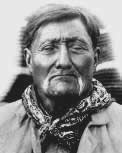
Timpanogos Leader Tabby
On the 12th of August (1872) General D. H. Wells received the following message from Colonel R. N. Allred of Spring City: Tabby sends word to all the Bishops, that he can control his men no longer. He was in Spanish Fork Canyon yesterday. I with a detachment brought the heard from Thistle Valley yesterday, having started as soon as I got word of the raid at Fairview. The wounded boy Stewart is dead.
Next day R. L. Johnson of Fountain Green, telegraphed to Indian Agent Dodge for troops to defend the people against some of the bands of savages who had become incensed on account of obedience to Dodges orders not to feed them as he would furnish them plenty on the reservations.
The following incident as related by Col. John L. Ivie, to his son James O. Ivie: 1868
During the Indian troubles in the 60's---the Indians had stolen some cattle, and driven them up North Creek Canyon, between Fairview and Mount Pleasant. Father John L. Ivie and his company of minute men were in pursuit, and going up the mountain they gathered up several head of cattle which had been left along the trail on account of not keeping up with the herd. And up among the timber was discovered a lone Indian covered up with leaves; he was sick, and not able to travel with the rest. Some of the boys wanted to kill him, but father said "no, we will not shed blood, unless it is necessary," so they left him and went in pursuit of the Indians and stock till nearly night, when it was decided to give up the chase and return home, taking back what stock they had.
On their return they came across the sick Indian sitting up against a tree smoking a pipe. The men still wanted to kill him, but father wouldn't let them. Sometime after that father and two men were standing guard over some stock in the north fort of Mount Pleasant; they would frequently meet and report to each other during the night, and had got together at the north side of the fort, when they heard and saw the cattle getting up from their bed-ground and moving away from what they might be Indians crawling among them. The cattle kept getting nearer and nearer to where the three men stood, when father spoke to the others and said, "they must be close by." After that they saw the cattle moving as if something among them was going away from them. When morning came nothing had been molested.
In the beginning of the 70's---after peace had been restored, an Indian and his family came to our house and spent a day or two. He told Father of the occurrence at the fort, explaining that he and four other Indians were there on that occasion and had their guns lying across a cow ready to shoot the three men, when they heard father speak and say, "they must be close by." He said he knew father's voice and would not let the others shoot as father had saved his life on the mountain when he was sick. In appreciation he had now saved father's life.
DAN MILLER KILLED AND SON WOUNDED NEAR SPRING CITY
The following sketch of the last killing of a white man by Indians during the Black Hawk uprising, was originally prepared by Peter Gottfredson, of Richfield, for the local paper, about 1882.
The last man killed in the Indian Wars of Utah was Daniel Miller of Nephi, Juab County. The tragedy took place on the morning of the 26 of September, 1872, at Snow and Douglas ' saw mill, in Oak Creek Canon, Sanpete County, three miles east of Spring City. The mill had shut down about a month before, it being considered unsafe to work there because of Indians, but William Higbee stayed there as watchman.
I had a contract to get out a bill of lumber to finish a new school house which was being built in the Second District at Mount Pleasant, and Thomas Gledhill, my brother-in-law, sixteen years old, was helping me. I was working three yoke of oxen, getting logs to the mill to be sawed on shares. Miller was building a house at Nephi, and he and his son, (Dan M. Miller), thirteen years of age, was working a pair of mules getting out logs for lumber to finish his house. All told, there were five of us at the mill.
The 26th of September, 1872, was Saturday. We were all going home except Higbee. The house in which we camped was about two hundred yards be
low the mill, between the road and creek, with the door toward the road east. About thirty yards east of the house at the side of the road lay a pile of poles. The Indians had placed two small poles, one on each end of the pile, and a large pole on top of them, making an opening to put their guns through There were marks in the dust where five Indians had lain, ready to fire, if we had all gone out together.
That morning we maneuvered differently from our usual custom. I arose at day-break and went up to the mill to saw out a few joints that I wanted, which were not in the mill yard, and to load my wagon. I called Gledhill to go after the oxen which were in the hills about a mile south of the mill. He left the house shortly after I did. Soon afterwards, Miller came up to the mill and loaded his wagon, and in a short time Miller's boy came up to the mill. Gledhill brought the oxen, yoked them, left them in the mill yard, and returned to the house. Soon after this I went down to breakfast and Miller and his boy started away. They passed the house with their load of lumber, drove about one hundred yards below the house, around a patch of oak brush which hid them from view, and then stopped to tighten the binder. The Indians had run down behind a low ridge where their horses were tied to the oak brush, and from ambush fired five shot, most if not all, taking effect. Miller was shot through one arm and in the side under the arm, and one bullet passed through his bowels, breaking his back. The boy was shot through one thigh and through one wrist, the ball passing between the two bones.
We heard the shooting, but thought the Millers were shooting at a rabbit or wolf and took no more notice of it. We finished our breakfast and all three started up to the mill after my team. When about half way up, we heard the rattle of a wagon, and in looking back we saw a man standing up on the wagon driving as fast as he could make the horses go. Tom Gledhill said, "That fellow is driving pretty fast up hill." I remarked, "he must have had one drink too many this morning." Just then the man shouted, there is a man shot all to pieces below the house. We then knew what the shooting was we had heard and started back to the house as fast as we could run. We saw some horsemen south west of the house coming at full speed through the brush, and thought they were Indians trying to head us off from the house, where we had left our guns. When we reached the house we saw that the men were from Spring City.
The Miller boy, when shot, tried to run to the house, but the Indians headed him off. They had not yet reloaded. The boy turned and ran down the road toward Spring City and met these men going out to look for stock. They had received word that Indian signs had been seen the previous evening in the foot hills. Some of the men took the boy who was very weak from the loss of blood to Spring City and sent a telegram to Mt. Pleasant. Col John L. Ivie gathered up a small posse with which he pursued the Indians, but never overtook them. Later Colonel Allred took young Miller home and kept him until he recovered. Brother Allred 's wife attended him like a mother without compensation.
We all went down to where Miller lay. When shot he had fallen off the wagon on the north side. The Indians, without mutilating his body, had dragged him about a rod from the wagon and laid his face on a large bed of cactus. They had taken his gun, pistol, food, bedding, and cooking utensils, and with the mules had made off in a northeasterly direction towards the mouth of Cedar Creek Canyon. It was then that R. N. Bennett, the man with the team drove up. He had seen the Indians leave, but thought they were white men. He saw the wagon, but did not notice that the tugs were cut. As he was passing the wagon he heard a man moan, and, turning, he saw Miller lying about a rod north. He stopped, tied the lines, and went to Miller and asked who had done this. Miller said, " Indians. " Bennett said, "When?" Miller answered, "Right now." Bennett asked if there was anybody at the mill and was answered, "Yes." He then lifted the old man off the cactus and drove up to the mill.
When we reached the place where Miller lay, I put my arm under his neck to raise him up for some of the others to pick the cactus briers out of his face, and in doing so I heard his back bone grate. I asked if it hurt him. He answered no, but that he was thirsty. One of the men stepped to the wagon to get some kind of a vessel in which to fetch some water, but the Indians had taken everything of that kind. He, however, picked up one of the bullets that had been fired by the Indians on the wagon.. I said ' ' My hat will hold water, ' ' and ran to the creek, about
fifty yards distant, where I received a moment's scare. On the opposite side of the creek some willows had been cut down and fire had been through them. One willow about the size of a gun barrel had been blackened by smoke so that it looked bright, and lay in such a position that it pointed right at my head. I thought that if I did not drop this instant, I would be shot. As I squatted to the ground I saw what it was. I obtained the water and let Miller drink out of my hat, after which we held consultation and decided to make a litter of four small poles and a pair of Higbee's blankets, using a pair of overalls belonging to me for strings to lash it together. Gledhill was sent to the house after a bucket, blankets and overalls. When he returned he was sent upon an elevation to guard against a surprise by Indians.
The Spring City men made the litter while Higbee and I followed the trail of the Indians to learn if possible, where they had gone. We were armed with good " Henry " rifles, and followed the trail to the mouth of Cedar Creek canyon, about two miles, where the Indians had gone up a wide hollow with large oak brush on both sides. I told Higbee that I was going there, as it gave the Indians too good a chance to ambush us without our getting a chance at them. He then said that he would go alone, and went on. I went onto a ridge where I could look around and could see no Indians, but saw one of Miller's mules feeding a short distance north with the harness on. I feared it might have been left there for a decoy to get us into a trap, but as the mule was feeding contentedly, I concluded
that it had been left because it was too slow to make headway. I secured the mule and took it back to the wagon. When I reached the vehicle the men were ready to start with Miller. Some of the men had gone up to the mill and brought down my team.
The Spring City men carried Miller, one at each corner of the litter, and Gledhill took Miller's wagon with one yoke of my oxen. I drove my wagon with the other two yoke. Having travelled about half the distance to Spring City, Miller said he was tired and wanted them to lay him down in the road to rest. We all gathered around him. I asked him if he would like us to take any word to his family if he should not live to see them. His eyes were turning glassy. He said he had nothing on his mind, but would like to see his twins before he died. We learned later that a pair of twin baby boys had recently been born to him. We asked him if he wanted us to take vengeance on the Indians. He said, "No, they don't know any better." He said he knew some of the Indians, one was Tabyany, and there were five of them. Other things were said that I do not call to mind. We could see that he was too low to proceed, and in a short time the poor fellow expired. Colonel Allred came up with a wagon, and his body was carried down to Spring City. That night his family, who had been telegraphed at Nephi, came to Spring City and took charge of his remains.
However, when within a few rods of the scene of their murderous work, a motion from Kanosh caused them to be quiet, when he upbraided them for their devilish work. Moshoquop then told the partial story of the massacre, and endeavored to exonerate himself by relating the circumstances of his father's death at the hands of the white men. Mr. Warner asserts that during the recital, tears streamed from Moshoquop's eyes and that his appearance was a mixture of fiend incarnate and savage affection.
The remains of Captain Gunnison and Wm. Potter were wrapped in blankets and taken to Fillmore where the captain was buried; those of Potter were sent to Manti for interment. Of the three surviving Indians, Carboorits, who shot at the Captain, has lost his eyesight, and is ending his days in darkness on the Indian farm near the town of Kanosh. Mareer and Sam, as previously stated, are living near Deseret. Mareer is fast hastening to the grave, and Sam is a muttering imbecile. Moshoquop died two years ago in Deseret. He was of medium stature, compactly built, and as lithe and wiry as a panther. His forehead was high and retreating, his bearing reserved and dignified, his face, while indicating strength and a fearless nature, was frank and not unkind. In spite of the terrible deed he planned and carried out so relentlessly, he was better than the average Indian. While his part in the Gunnison tragedy cannot be justified by revenge for the death of his father, it is somewhat palliated by reflecting that his nature like that of all other
Indians was the result of generations of trasmission of ideas and customs incident to the environment of the red men.
FOUR MEN KILLED AT UINTAH SPRINGS, SANPETE COUNTY
On September 30th, 1853, a party of four men, William Reed, James Nelson, William Luke and Thomas Clark, started from Manti, Sanpete County, with ox teams loaded with wheat for Salt Lake City. It was arranged that they were to camp the first night on the Sanpitch River, near where Moroni is now located, and wait there until a company with horse teams under the leadership of Isaac Morley should overtake them ; then they were to travel slowly together through Salt Creek Canyon ; but contrary to arrangements they went on to Uintah Springs (now Fountain Green) and camped for the night. Early on the morning of October 1st their camp was attacked by Indians and all four men were killed. The savages had time in this instance to complete their fiendish work, mutilating the bodies of their victims to such a degree that when found they could scarcely be recognized. When Morley 's company came along they found three of the bodies of the murdered men, but the body of Clark had been covered up in the wagon with wheat that the Indians had emptied out of the sacks which they had taken away with them.
SKIRMISH AT NEPHI, JUAB COUNTY. EIGHT INDIANS KILLED
The company went oh to Nephi at the mouth of Salt Creek Canyon, and on the morning of the 2nd of October encountered a camp of Indians and had a skirmish, in which eight Indians were killed and one squaw and two boys taken prisoners. When they reported in Utah County, a possee of about twenty men from Springville, Spanish Fork and Payson was organized under command of James T. Guyman. They went to the Uintah Springs and found the remains of Thomas Clark under the wheat in the wagon. He had been scalped, his head crushed and his body cut open and his heart taken out. The posse went on to Manti and reported. They were accompanied by George Peacock from Springville who returned with the posse. At Manti they learned of the killing of William Mills and John Warner near Manti on the 4th. On their return the company stopped and buried the remains of Clark which was by then badly decomposed. It was said that George Peacock, who was a relative of Clark, got the body and buried it at Manti. The particulars here given were obtained from Samuel T. Curtis of Salem, Utah County, who was one of the posse.
WM. MILLS AND JOHN E. WARNER KILLED AT MANTI, SANPETE COUNTY
On October 4, 1853, William Mills and John Warner were killed by Indians, near Manti. The following particulars are copied from a sketch written by Eunice Warner Snow, wife of John E. Warner one of the men killed at Manti, October 4th:
"On the 4th of October, 1853, my husband was killed by the Indians in the edge of Manti Canyon while attending the grist mill. Mr. Warner, my husband, owned one third of the mill at the time he was killed, and it fell to his lot to attend the mill and grind the wheat for the people of Manti. The mill was situated about a mile from town. He had taken a number of men with him as a guard until the day he was killed. On that day it seemed there was no one who was willing to go with him. A man by the name of William Mills offered to go, as he needed some wood. He said he would take his oxen and cart and while Mr. Warner was grinding a grist, he would go into the mountains close to the mill and get some wood.
Mr. Warner would not let him go out alone, so they both went out a short distance from the mill, but before they went, my husband filled the hopper with wheat. He had taken his gun with him every day and had killed two rabbits the day before. I was cooking them for his supper when word came that he had been killed. We heard the report of the guns that killed the two men, but paid no attention to it as we had heard similar shooting before when my husband killed the two rabbits.
The men were killed in the morning, as we thought. Soon after dinner a young man went up to the mill for some flour. There was no one to be found around the mill, which was running at full speed, but had no wheat in the hopper. He knew something was wrong and came to town as fast as he could and told the condition in which he found the mill. They soon found a number of men to go in search of Warner and Mills and found their bodies a short distance from the mill.
The cattle had also been killed with poisoned arrows. The Indians had been in ambush waiting for an opportunity to do their work. Both men were stripped naked, except that my husband had his garments left on him. I was not allowed to see him as he was so badly disfigured in the face. The Indians, after they had tried to make peace with our people told that Mr. Warner had fought desperately and killed one Indian. Soon after the killing an Indian came to our house carrying my husband's gun, and one day two Indians came to our door, one of whom had my husband's neck tie on his black neck; the other had his pocket rule, which he always carried with him, and also his pen knife. This knife was a useful one, as it contained a number of articles, such as a button hook, an ear spoon, etc. Two or three articles they had broken up. _They were showing these things to my father and mother at the table as we happened to be eating dinner at the time. I grabbed a butcher knife which was lying on the table and started for them. My father seeing me rise from the table, caught me in his arms and carried me out of the room. It was more than I could stand to see the black imps with my husband's things. This happened a short time before the birth of my son, who was born six months after my husband was killed.
Another serious trouble came of which I will make mention; Soon after my son was born, Chief Walker came to our house one day. He said he intended, when I got around again, to have me for his wife. He told my father and mother his intentions. They did not let me known anything about it until he came several times to see me ; when they told me it almost frightened me to death. I was obliged to keep in hiding from him for about six weeks, in fact until the good news came one morning that Walker was dead. He died very suddenly.
ATTACK AT SANTAQUIN, UTAH COUNTY. FERNEE L. TINDRELL KILLED
On October 14, 1853, Indians attacked the infant settlement of Summit (now Santaquin), Utah Co., of which occurrence Albert Jones, of Provo, Utah County, wrote the following : The settlers of Santaquin had been driven from their homes, and had made their temporary residence at Payson, that being a more populous town and able by its numbers to defend itself against the Indians who were then on the war-path under the lead of their chief Wah-ker. Crops had been planted at Santaquin that spring and a small party owning land there had come from Payson in the morning of Oct. 14, 1853 to harvest their potatoes. Among the number were Jonathan S. Page, Fernee L. Tindrel, Sybrannus Calkins, (a Mormon battalion boy) and John Sheffield, then a lad of about fifteen years. These harvesting parties came and returned to Payson the same day.
On the morning of this day one of the boys going over the hills with some companions espied a wolf and could not resist taking a shot at the brute, although that was contrary to orders in those days, as the firing of a gun was the signal agreed upon announcing the approach of Indians. The older people were alarmed on the instant, but upon finding out the cause of the shot, reprimanded the boys and returned to their several patches of potatoes, working with a will to secure them for their winter's use. About 2 p. m. firing was heard again, but the men had grown careless, thinking it was the boys shooting again. However, as the shooting continued, the parties became alarmed, and Jonathan S. Page and Sybranus Calkins, who were working together, looked up from their work and saw a number of Indians in the distance firing at Furnee L. Tindrel and the boy John Sheffield. They saw Tindrel run quite a distance and then fall, but lost sight of the boy entirely.
"The Indians, " said Captain Jonathan S. Page, who narrated this incident of the early Indian wars, "came straight on towards us, firing at us as they came. We prepared to take off a wagon box for breast works and fight them, but so many of them came in view through the oak brush and corn that we decided to leave and run to the main body of harvesters. We had two yoke of oxen with us, one yoke chained to a wagon got so excited and sagged back on the chain, so that we could not unhook it. We started off driving a yoke of Calkin's cattle before us, but they were so heavy and moved so slow, that we abandoned them, and away we ran. The Indian war-whoop was ringing in our ears, and the bullets whistling around us. I was young and a good runner, and with that horrid war-cry to urge me on, I cleared the three foot sage brush in our path like a deer. Calkins who had been exposed in his service in the battalion, could not keep near me and called out, "Page you ain't going to leave me?" I slackened speed until he came up. The bullets and arrows were whistling and screaming around us again.
We renewed our pace, the Indians pressing close behind us, until we came to a thicket of large oak brush, into which we rushed for shelter ; the Indians soon approached above us on a ridge not a rag on them. Their red bodies shone and glistened in the sun. They must have been greased. They danced about the ridge, waving the scalp of poor Tindrel, and shouting their terrible war-cry. The thrilling effect is felt when imitated in our sham battle in the celebration of the twenty-fourth of July, but in the position we were in at the time, its terrifying effect had full force and our hair stood on end.
As we dashed into the thickest oak brush we saw Abel Butterfield (a man noted for his great size and strength) on another ridge. We called to him that the Indians were upon him and that he had better run for safety. It seemed to daze him, as we looked out from our hiding places, we could see the old man (we always called him old) walking up and down on top of the slope opposite the Indians, waving his arms, and calling with his stentorian voice for the boys of Payson and the boys of Spring Creek to come on.
This ruse, no doubt, had its effect, for the Indians did not advance farther. They continued to cry to us to come out of the brush and attack them. They dared not come near us. I had a Kentucky rifle that carried a ball about as big as a pea, while Calkins had an old time Taylor rifle. After some time the Indians withdrew and went to the wagon and the cattle we had left.
There were two other yoke of cattle there belonging to James Holman. The Indians shot and killed the oxen chained to the wagon and drove off the others with them. Luke Holman and Levi Colvin came up to the thicket where we had hid. There were now five of us, and we followed on after the Indians in hopes of getting the cattle back. The Indians saw us coming and divided their party, some continuing on with the cattle, while the rest made southward, toward Santaquin canyon. Here I found a good opportunity to count them, and made out thirty-nine. We thought they might have had horses at the mouth of the canyon, and concluded we had better turn back for fear they would cut us off from the main body of harvesters. We then went back to the rest of the people, who numbered about nine.
Levi Colvin had a pair of horses there, and Jonathan Davis mounted one of them and rode down to Payson to give the alarm ; soon about forty men in wagons and on horseback were hastening to our relief, in charge of Col. W. C. McClellan. Eobert E. Collet (later of Pleasant Grove) also ran into Payson on foot, following down the creek northward, and arrived there soon after the horsemen got in.
Levi Colvin and myself, before the relief party came, went up through the brush and found the body of Tindrel ; he was scalped, and all his clothes were off, except his shirt. He was shot seven times. Two bullet holes and five arrows were found in his body.
The reason they had not taken off his shirt, was that one of his arms was pinned to his body with an arrow. One arrow had gone through the body, entering the back and protruding at the breast bone ; one bullet passed through him close to the heart, and he must have run seventy-five yards at least, after again.
CHASE'S SAWMILL IN SANPETE COUNTY BURNED BY INDIANS
November 6th Chase's sawmill in Sanpete County, was burned by Indians. Three days later, November 9th The Indians burned six houses in Summit Creek (Santaquin) Utah County, which had been vacated during the summer.
THE ALLRED SETTLEMENT, (SPRING CITY) BURNED BY INDIANS
1854, Jan. 6th Allred's settlement (Spring City) Sanpete County, which had been deserted the previous summer because of Indian troubles, was burned to the ground by Indians. April. A number of Elders was called on a mission to the Indians in southern Utah. This more directly resulted in opening up that part of Utah south of the rim of the great basin to settlement.
TREATY WITH CHIEF WALKER AND KANOSH. END OF UTE WAR
In May, 1854, after a "talk" with President Brigham Young, the Indian chief Walker (Surrounded by his braves) and Kanosh, chief of the Pahvant Indians, entered into a formal treaty of peace at Chicken Creek, Juab County. This ended the Ute war, during which nineteen white persons and many Indians had been killed. During the war a number of the smaller settlements had been broken up, and their inhabitants moved to larger towns.
August 8th William and Warren Weeks, sons of Bishop Allen Weeks, were killed by Indians in Cedar Valley.
ATTACK ON WILLOW CEEEK, (MONA). ISAAC DUFFIN WOUNDED
August 10th 1852. Lieutenant R. Burns and a company of ten men, encamped at a small settlement on Willow Creek Mona in Juab County, were attacked by Indians, and during the fight that followed, Isaac Duffin was slightly wounded in the knee. Two of the soldiers had their horses killed, and one Indian was sent to the "happy hunting grounds. " About this time Colonel Conover was ordered back from Sanpete to guard the settlements of Utah County and assist in putting them in better condition of defense.
AT PARLEY'S PARE, TWO MEN KILLED, ONE WOUNDED
On the 17th of August 1853, four men John Dixon, John Quayle, John Hoagland and John Knight, were hauling lumber from Snyder's saw-mill in Parley's Park, when they were fired upon by Indians in ambush and two of them instantly killed. These were John Quayle and John Dixon. Hoagland was wounded in the arm, but was able to help Knight detach two of their horses, upon which they rode with all speed to Salt Lake City. Barely escaping with their lives; they left their wagon, four horses, two mules, and the dead bodies of their companions behind them. Their savage assailants did not linger long in the neighborhood of the massacre, not even long enough to scalp or otherwise mutilate the dead, according to their custom. Taking the animals they hastily decamped, and though followed by an armed party from Salt Lake City, as soon as the news of the killing reached there, they were nowhere to be found, though diligently sought for in all the surrounding region. Another John Dickson, the spelling of whose name slightly differs from that of the i other man killed in Parley 's Canyon, had been shot by Indians near Snyder's Mill a short time before.
Treaty at Heber
The spring of 1867 was late and the snow deep in the hills. We put out our guards, but no Indians troubled us until about the middle of July. We had a special scout independent of the usual scouts, namely John Cummings, who on a certain occasion found in a side Canyon an Indian who had skinned an ox and was in the act of cutting up the meat. Mr. Cummings covered the Indian with his rifle and drove him ahead of him to Heber City where he was kept under guard three days. A court marshal decided to write a note to Chief Tabby, advising him to keep his Indians at home, and also asking Tabby to come over and make peace with us. We gave the note to the Indian and told him to go immediately to the Reservation, give the note to Chief Tabby like a good Indian.
Two guards went with him to see him over the ridge. About a month later, or about the 15th or 20th of August, Chief Tabby with his whole tribe, squaws, pappoosses and peaceable Indians that he could control came here. The Chief said that he could not control those of his Indians who were with Black Hawk. We had a bowery in which we held summer meetings, and in this we set large tables, and the ladies furnished a good picnic for the Indians. An ox was killed and roasted, (a fine barbeque) and the Indians filled up good; the pipe of peace was passed around, and the Indians after stopping a few days returned home with a few good presents. On leaving our valley these Indians stole thirty of our horses.
NOTE: Only the federal government could make treaties with Native peoples. Though several so called 'treaties' were made between Mormons and the Timpanogos Nation. They were only agreements, none were legally binding. They were divisive at best.